Dear reader,
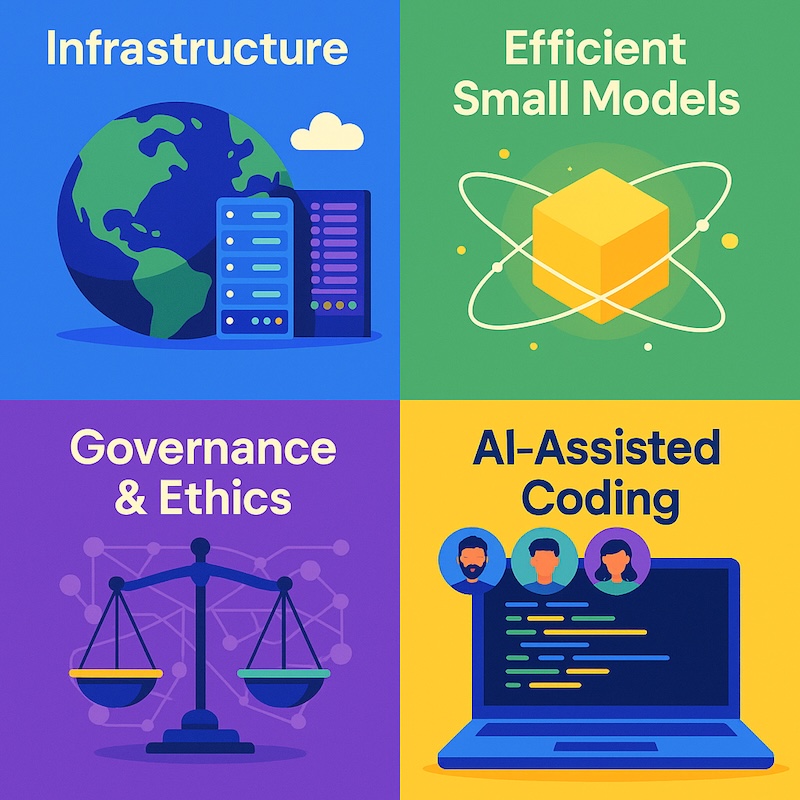
This week, AI quietly strengthened its foundations.
At one end, NVIDIA’s new supercomputers are pushing science to exaflop speeds.
At the other, IBM released small open models that fit right on our laptops.
And somewhere in between, GitHub taught coding assistants to work as a team.
Three stories, one theme: AI is becoming more balanced — powerful where it needs to be, and personal where it matters most.
Weekly AI Signals: Key Takeaways
| Signal | Industry Impact | Builder Action |
|---|---|---|
| NVIDIA Exaflop Hubs | Massive, centralised supercomputing accelerates scientific breakthroughs and brute-force foundational model training. | Accept that raw, hyperscale compute will remain centralised; focus local development on targeted inference, not base-training. |
| IBM Granite 4.0 Nano | Democratises local edge AI with highly capable Apache-licensed models (350M–1.5B parameters) running natively in browsers. | Deploy Granite Nano for local summarisation, routing, and simple parsing tasks without paying API overhead. |
| GitHub Agent HQ | Transitions AI assistance from a single pair-programmer autocomplete to an autonomous, multi-agent, collaborative engineering team. | Redesign your development workflow to assign distinct roles (planner, reviewer, coder) to specialized LLM personas within your IDE. |
NVIDIA’s Exaflop AI Infrastructure Hubs
An exaflop system is a supercomputer capable of one quintillion (10^18) floating-point calculations per second — a 1 followed by 18 zeros. NVIDIA and U.S. national labs are building AI supercomputing hubs at this scale for science, climate research, and training massive models.
These exaflop-class machines operate at one quintillion (1,000,000,000,000,000,000) calculations every second. Unimaginable speed!
When I read this, I imagined endless GPU racks somewhere, glowing and humming through the night, while I fine-tune tiny models on my laptop. It’s humbling — the scale of it all — and exciting that both ends of this world now talk to each other.
IBM Granite 4.0 Nano: Small Open Models for Edge AI
Granite 4.0 Nano is a series of open-weight IBM language models ranging from 350 million to 1.5 billion parameters, small enough to run on laptops or in-browser. This week, IBM introduced the Granite 4.0 Nano series. The Granite 4.0 Nano models are Apache-licensed, efficient, and ready to fine-tune for your own experiments.
I love these small models. They feel personal — like pocket-sized labs I can play with anywhere. My Mac stays quiet, my ideas move faster, and I don’t have to think about power bills or GPUs in distant rooms.
Zoom also updated its AI Companion with NVIDIA’s runtime stack — faster replies, smaller energy use, smoother collaboration.
👉 NoJitter — Zoom Rolls Out Upgrade for AI Companion
I like the pattern here: AI that fits in our tools instead of taking them over. That’s progress you can actually feel.
GitHub Agent HQ: Multi-Agent AI Coding Collaboration
GitHub Agent HQ is a coordination layer that lets multiple AI coding assistants operate together inside VS Code, each assigned a distinct role. GitHub’s new Agent HQ lets multiple AI assistants work together inside VS Code. Not just one Copilot — a team. One plans, another codes, another reviews.
👉 The Verge — GitHub is launching a hub for multiple AI coding agents
Sometimes I picture them like colleagues debating pull requests. One argues for recursion, the other for a rewrite. I just sit there with tea, listening — equal parts amused and impressed.
If you had your own AI team, what would you hand them first — debugging, documentation, or the part you’ve been avoiding all week?
As multiple agents begin collaborating inside our editors, new questions surface — about trust, responsibility, and transparency. For a broader look at how these challenges might reshape accountability in the next wave of AI, Bernard Marr’s recent Forbes article, 8 AI Ethics Trends That Will Redefine Trust & Accountability in 2026 , offers thoughtful insights into the responsibilities of autonomous agents and the growing role of regulation. (Some readers may encounter a paywall.)
Weekly AI Trend Analysis: Infrastructure, Small Models, and Multi-Agent Coding
This week’s signals show AI infrastructure specialising along two axes at once: centralised exaflop-scale hardware for foundational training, and sub-2B-parameter open models for local deployment. AI is stretching in both directions right now — wider and smaller, faster and closer.
Hardware & Workflow Alignment
| Vector | Trend | Technical Destination |
|---|---|---|
| Wider & Faster | Exaflop hyperscale supercomputing. | Massive infrastructure dedicated solely to scientific discovery and foundational base-model training. |
| Smaller & Closer | Open-weights, sub-2B parameter models. | Highly accessible, local-first creation and deterministic inference running on consumer edge devices. |
| Collaborative | Multi-agent orchestration within IDEs. | AI shifts from a reactive assistant to proactive, compartmentalised software engineering teams. |
The pattern is balanced — not more or less AI, but better-placed AI, ideally explainable and trustful.
Have a lovely weekend,
Elena
Stay Ahead in AI, Machine Learning & Python
No hype. Weekly notes on AI tools, Python, and what I'm actually building — plus seven free gifts, including Fantastic AI: The 2026 Toolkit and Git Commands and Contribution Workflow Cheatsheet.
You're in
Check your inbox for Set a password to unlock articles if you want gated tutorials. Log in with the same email.