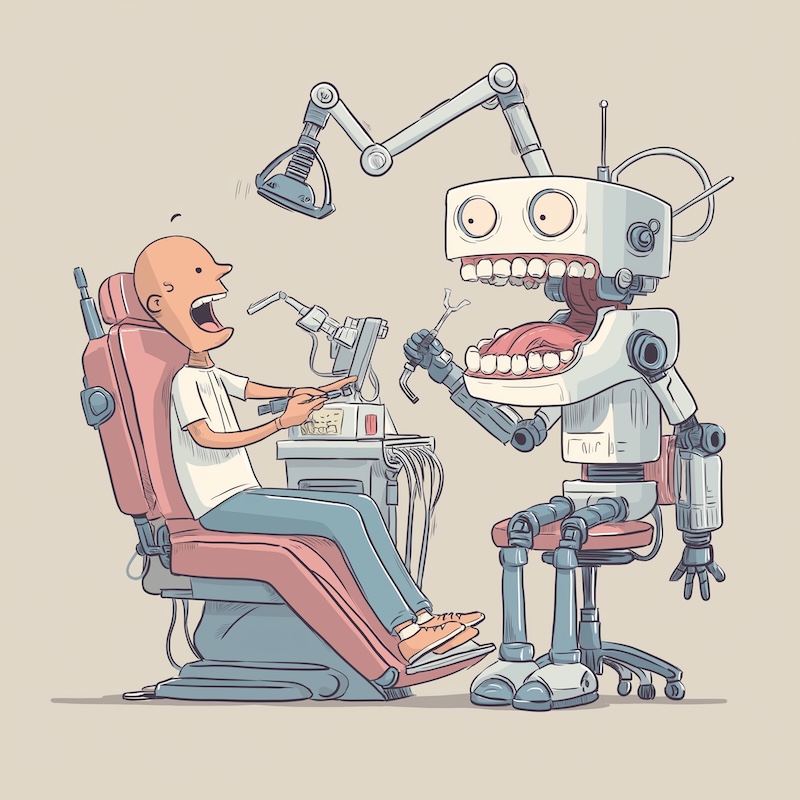
I went to the dentist today. You know, the adult version of a school exam, except the chair is oversized and the lighting is uncomfortably good. The hygienist always asks “Any concerns?” and suddenly my brain goes blank. Which teeth do I even have? Where are they located? What is a molar?
They tilted the chair back, switched on that tiny headlamp of truth, and my soul decided to take a brief walk around the waiting room. Many years ago I lost a tooth to a small stone hiding in my food. Today I am finally getting a new one — not real, but perfect. 🦷
Please wish me luck. :)
Also, considering all the dental suffering in human history, where are the AI dentists? Surely robots could make this process less terrifying. Or at least tell better jokes while drilling.
AI and Robotics in Dentistry: What Changes in the Next 2–7 Years
After today’s adventure, I got curious: what is actually happening in dental tech while we are all lying back practicing controlled breathing?
AI-assisted dentistry is a category of clinical practice that uses machine learning models to support diagnosis, risk prediction, and robotic-assisted procedures alongside — rather than instead of — the dentist’s own judgment. The future is arriving quietly. No robot dentists hovering over you like in sci-fi films. Just small upgrades that make appointments less mysterious and faster.
The AI Dentistry Evolution Matrix
| Clinical Domain | Current Human Baseline | AI & Robotics Integration | Scientific Evidence |
|---|---|---|---|
| Diagnostics & Imaging | Manual review of X-rays; risk of missed early decay; higher radiation needs. | Automated anomaly highlighting; enhanced image resolution requiring lower radiation exposure for patient safety. | Ali et al. (2025) [2] highlights improved safety and diagnostic accuracy via AI radiology. |
| Caries Detection | Universal visual/tactile inspection; reactive treatment. | Individual risk profiling; cost-effective early detection tailored to specific patient histories rather than raw data volume. | Schwendicke et al. (2022) [1] found AI improves cost-effectiveness when paired with individual risk profiles. |
| Robotic Intervention | Manual drilling and archwire bending limited by human dexterity. | Robotic arms provide “refined and precise movements” exceeding human capability for complex tasks, acting as a co-pilot. | Liu et al. (2023) [3] detail the automation of crown prep and archwire bending without replacing the dentist. |
| Long-term Prevention | Reactive treatment based on symptoms manifesting physically. | Machine learning models forecast periodontal disease progression months or years before symptoms occur. | Patel et al. (2022) [4] demonstrate predictive modelling for periodontal disease using big clinical data. |
Instead of reacting to problems, care becomes a series of gentle nudges — earlier, more personalised, less stressful. Your dentist translates the AI output into normal human language—no surprise quizzes about molars.
AI-assisted dentistry represents a diagnostic support layer that augments clinical judgment rather than replacing it — sharpening detection, timing, and precision while leaving treatment decisions in the dentist’s hands. The coming wave is not about replacing dentists. It is about giving them clearer signals, steadier tools, and better predictions — and giving us a calmer, more transparent path to healthy teeth.
Stay Ahead in AI, Machine Learning & Python
No hype. Weekly notes on AI tools, Python, and what I'm actually building — plus seven free gifts, including Fantastic AI: The 2026 Toolkit and Git Commands and Contribution Workflow Cheatsheet.



You're in
Check your inbox for Set a password to unlock articles if you want gated tutorials. Log in with the same email.