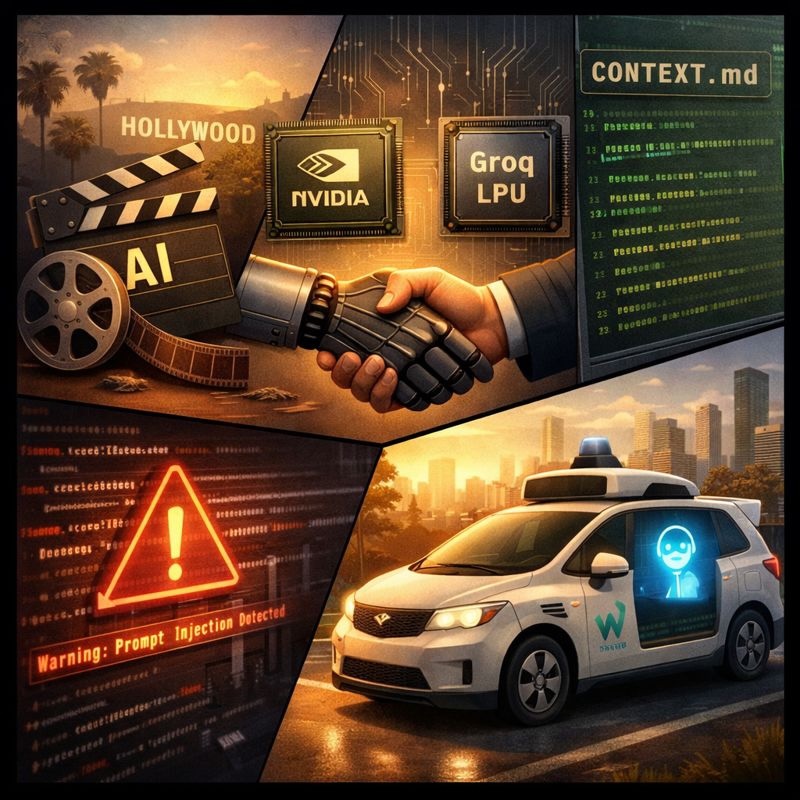
This post is part of my Weekly AI Signals series — a curated look at the moments that matter once the noise fades.
Weekly AI Signals: Five AI Developments From Late December 2025
Five Signals That Mattered
Hello, dear reader! Welcome to the last week of December 2025. I hope you are enjoying the holidays and have had a moment to look back on what has been an extraordinary year for AI.
This is not a complete account of everything that happened in AI this week. Instead, it is a small, curated set of signals that felt meaningful once the noise settled — moments where limits became visible, incentives shifted, or assumptions quietly changed.
If 2025 was the year we kept asking “what can we build?”, this past week felt like the moment the industry started asking a more useful question: “what actually works?”
The five signals below come from very different places — creative industries, hardware, developer practice, security, and physical systems — but together they point to the same thing. AI is moving out of its novelty phase and into an engineering one.
Here is what stood out, and why it may matter longer than this week’s headlines.
Weekly AI Signals: Key Takeaways
| Signal | Industry Impact | Builder Action |
|---|---|---|
| Hollywood’s AI Quality Problem | Scale without quality fails: Amazon pulled AI-dubbed anime for robotic delivery and lack of emotional nuance. | In consumer AI, novelty fades fast. Prioritise quality, taste, and editorial judgment over raw generation speed. |
| Nvidia–Groq $20B Deal | Training and inference officially require different hardware stacks; Groq’s LPU targets low-latency inference. | Expect real-time AI costs to drop significantly in 2026; design applications now for sub-100ms inference budgets. |
| Context Engineering | Repos with explicit CONTEXT.md files generate significantly better AI coding output than prompt-only approaches. |
Add a CONTEXT.md to your repo root today; document language, architecture patterns, and testing constraints. |
| Prompt Injection Is Permanent | OpenAI formally admitted prompt injection cannot be fully eliminated — analogous to SQL injection in web security. | Never use an LLM as a security boundary; layer application-level validation and monitoring around all AI decisions. |
| Waymo + Gemini In-Car AI | Conversational AI moves from screens into physical, ambient environments (in-car passenger interfaces). | Begin designing context-aware, environment-sensitive AI interactions where screen-free UX is the constraint. |
1. Hollywood Discovers That Creativity Cannot Be Automated (Yet)
Hollywood's AI Experiment in 2025: Hype, Scandals, and a Flood of Low-Quality Content
As 2025 draws to a close, retrospectives on the entertainment industry’s use of generative AI reveal a consistent problem: scale without quality.
Despite massive investments — including Disney’s widely reported partnership with OpenAI — studios struggled to deliver compelling results. This month’s most visible failure was Amazon’s AI-dubbed anime releases, which were quietly removed after audiences criticised their robotic delivery and lack of emotional nuance.
What’s revealing is not that AI struggled, but where it struggled. Generative systems can produce video quickly and cheaply, yet they still fail to capture intent: cultural context, emotional timing, and deliberate storytelling choices.
In consumer-facing AI, novelty fades fast. Speed alone does not create value. Quality, taste, and human judgment remain the differentiators.
Interestingly, while creativity hit its limits, something very different was happening lower in the stack.
2. Nvidia and Groq: The $20 Billion Hardware Handshake
Nvidia to license AI chip challenger Groq’s tech and hire its CEO
On December 24th, Nvidia announced a strategic licensing deal with Groq, reportedly valued at $20 billion, marking one of the most significant AI hardware collaborations of the year.
Groq’s Language Processing Unit (LPU) is a purpose-built inference chip architecture that optimises for low-latency, sequential token generation rather than the large-batch parallel throughput that GPUs are tuned for during training. Nvidia continues to dominate large-scale model training. Rather than competing across the entire pipeline, this deal acknowledges a reality developers already feel: training and inference have different optimisation needs.
Groq’s leadership and engineers will support Nvidia’s efforts to scale low-latency inference, while Groq remains independent — a rare example of cooperation in a fiercely competitive space. Nvidia’s own hardware roadmap and inference tooling are documented in the Nvidia Developer resources; Groq publishes LPU architecture details on its Groq site.
This is a strong signal that real-time AI applications will become cheaper and more accessible in 2026. Faster inference unlocks practical use cases that previously felt out of reach.
But faster models alone are not enough. We also need to communicate with them better.
3. Context Engineering: The New Frontier in AI Coding
An Empirical Study of Developer-Provided Context for AI Coding Assistants in Open-Source Projects
A research paper published on December 21st analysed 401 open-source repositories and surfaced a pattern many developers will recognise: AI coding tools perform best when given explicit structural context.
Context engineering is a development practice that supplies AI coding assistants with structured project metadata — architecture patterns, style constraints, and testing rules — instead of relying on prompt phrasing alone to convey that information. Rather than endlessly refining prompts, teams are adding context files that explain architecture, style, and constraints. The insight is simple but powerful:
An AI coding assistant is only as good as the context it can read.
A practical example is adding a CONTEXT.md file at the root of your repository:
# CONTEXT.md
- Language: Python 3.12
- Style: small pure functions, no globals
- Architecture: service layer + repository pattern
- Tests: pytest, no mocks unless unavoidable
Something to try: Add this file today. It improves AI output and makes expectations clearer for human collaborators.
4. OpenAI’s Admission: Prompt Injection Is a Long-Term Risk
OpenAI admits prompt injection is here to stay as enterprises lag on defenses
On December 22nd, OpenAI publicly acknowledged that prompt injection attacks are unlikely to ever be fully eliminated.
Prompt injection is a security vulnerability class in which adversarial instructions embedded in untrusted input — web content, tool outputs, retrieved documents, or user messages — override an LLM’s intended system instructions. OpenAI’s admission treats AI security the same way the industry treats web security issues like SQL injection: not as a bug to fix once, but as an ongoing risk class to manage with layered defences.
Security guidance: never let an LLM be the final authority on decisions that matter. Application-level input validation, output monitoring, permission scoping, and layered defences remain essential. Models can assist with detection and triage — but they cannot themselves serve as the security boundary.
5. Waymo and Conversational AI Beyond the Screen
Waymo is testing Gemini as an in-car AI assistant in its robotaxis
This week also confirmed that Waymo is testing Google’s Gemini model as an in-car conversational assistant.
Gemini does not drive the vehicle. Instead, Gemini acts as a passenger-facing interface — answering route questions, adjusting the environment, or explaining vehicle behaviour. Google documents the underlying model family in the Gemini API docs.
AI is moving off screens and into physical spaces. In 2026, the challenge will be context awareness — understanding not just language, but environment, timing, and human expectations.
AI’s Shift From Novelty to Engineering Discipline
The final week of December 2025 felt like a quiet turning point. The “magic” phase of AI — where novelty carried everything — is fading. The engineering phase is taking its place.
This week’s five signals represent AI’s transition from a novelty-driven hype cycle to an engineering discipline defined by measurable hardware constraints, layered security practice, explicit developer context, and physical-world deployment. That shift is good news.
It means fewer demos and more systems. Fewer promises and more constraints. And ultimately, more reliable tools that earn trust through behaviour rather than spectacle.
As we head into 2026, I’d love to know: which part of AI feels most “real” in your work right now — the models, the tooling, or the constraints?
I hope you have a wonderful weekend, and happy building!
Stay Ahead in AI, Machine Learning & Python
No hype. Weekly notes on AI tools, Python, and what I'm actually building — plus seven free gifts, including Fantastic AI: The 2026 Toolkit and Vibe Coding Checklist.
You're in
Check your inbox for Set a password to unlock articles if you want gated tutorials. Log in with the same email.