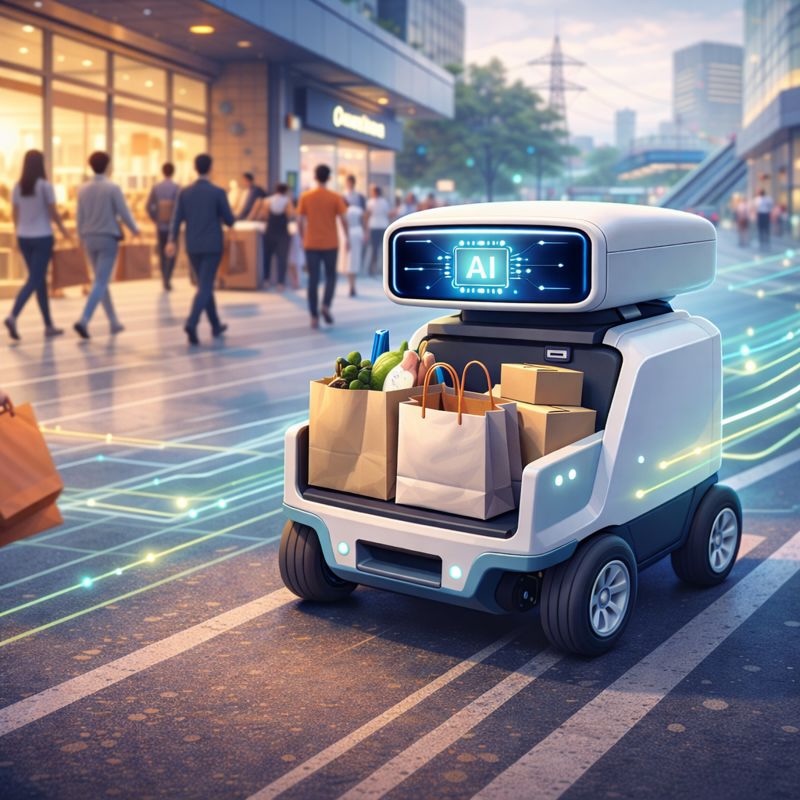
This week in AI felt a little different to me. Fewer headlines about dazzling benchmarks or clever prompts — and more about where AI actually lives, who powers it, and how it starts to touch everyday systems.
What I found interesting is that all four stories below point in the same direction — not toward new capabilities, but toward where AI is settling in the real world. Chips, electricity, assistants we already talk to, and even shopping flows. Less magic. More plumbing. And that’s often where the most important shifts begin.
Let’s take them one by one.
1. TSMC’s Massive AI Investment Signals Continued Boom
TSMC raises 2026 spending forecast amid explosive AI demand
On January 15, Taiwan Semiconductor Manufacturing Co. (TSMC) reported earnings that quietly confirmed something many in the industry have been sensing for a while: AI demand is no longer speculative — it is being planned for years in advance.
The company announced that its 2026 capital spending will reach between $52–56 billion, a sharp increase that reflects sustained demand for advanced chips used in AI workloads. Alongside this, TSMC forecast close to 30% revenue growth for 2026 and confirmed that its 2025 revenue reached $122 billion, crossing the $100B mark for the first time.
What stood out to me here is not just the size of the investment, but its timing. Semiconductor capacity cannot be spun up quickly. These decisions assume that today’s AI demand — particularly for accelerators — will persist well into the second half of the decade.
TSMC disclosed that AI accelerators already accounted for a high-teens percentage of its 2025 revenue, with expectations of mid-to-high-50% compound annual growth in that segment through 2029.
This goes well beyond excitement about the next model release. It’s factories, equipment orders, and long-term confidence. AI demand here is shaped by accelerator designers and large cloud build-outs — with companies like Nvidia frequently cited as direct customers, and hyperscalers influencing scale through sheer volume.
Why This Matters
If you want to understand where AI is heading, it helps to watch who is committing tens of billions of dollars before the revenue arrives.
TSMC’s raised spending forecast suggests that AI workloads are no longer viewed as cyclical or experimental. They are being treated as structural — closer to smartphones or cloud computing than to a passing technology wave.
For developers and startups, this quietly answers an important question: is AI infrastructure still a bet, or has it already become an assumption?
TSMC’s actions suggest the latter.
2. Apple and Google Gemini: A Quiet Shift in AI Alliances
Joint statement from Google and Apple
Earlier this week, Apple and Google confirmed a multi-year collaboration in which Google’s Gemini models and cloud technology will help power Apple Intelligence features, including an upgraded Siri, according to CNBC.
This deal reframes how Apple approaches AI on its devices. Rather than relying solely on its own in-house models, Apple has chosen to integrate Gemini models as the foundation for future versions of its AI systems. That includes Siri’s long-anticipated upgrade, expected later this year, as well as other personalised experiences.
The companies issued a joint statement saying that after a careful evaluation, Google’s technology “provides the most capable foundation for Apple Foundation Models”, and that this partnership will unlock new experiences for users while still honouring Apple’s privacy commitments by running key features on Apple devices and its own Private Cloud Compute systems.
Why This Matters
The point here isn’t a flashier Siri. It’s a structural choice: Apple is now willing to depend on a partner’s core AI models to power the next generation of its assistant and AI features.
That signals an important shift in how tech giants approach AI. Rather than each trying to build everything from scratch, some are starting to combine strengths where it makes strategic sense. For end users, that may mean smarter, more capable assistants on their existing devices — even if the heavy lifting happens quietly in the background.
It also raises thoughtful questions about design: how much should users care who powers their AI, versus what it delivers? This partnership suggests Apple believes the experience matters more than proprietary ownership — at least for this generation of AI features.
3. Microsoft’s “Community-First AI Infrastructure”
Community-first AI infrastructure
On January 13, Microsoft announced a new Community-First AI Infrastructure initiative, explicitly framing its data-centre expansion around being a “good neighbour” — addressing electricity use, local jobs, and regional impact.
This comes at a moment when U.S. data-centre electricity demand is projected to more than triple by 2035, according to BloombergNEF estimates reported by major outlets.
Microsoft’s message is careful and pragmatic: AI needs power, land, water, and community trust. Those are no longer abstract concerns.
Why This Matters
For years, AI felt weightless — something that lived in “the cloud.” But clouds are driven by very physical things.
As AI workloads scale, questions about where data centres go, how grids cope, and who benefits locally become unavoidable. Microsoft’s initiative doesn’t solve those challenges, but it does acknowledge them openly.
That alone is a shift. It suggests that AI infrastructure is now part of urban planning conversations — not just engineering ones.
4. Google Pushes AI Toward Real Transactions
New tech and tools for retailers to succeed in an agentic shopping era
Earlier this week, on January 11, Google announced a new push to turn AI assistants into something more practical: a bridge between conversation and commerce.
The company introduced the Universal Commerce Protocol (UCP) — an open standard that enables AI agents to communicate directly with retailer systems for discovery, checkout, and support.
Initial implementations will power checkout features in AI Mode in Search and in the Gemini app, starting with eligible U.S. retailers, with Google Pay support and PayPal integration planned.
This isn’t about impulse shopping via chat. It’s about wiring AI into existing commercial rails.
Why This Matters
So far, AI assistants have mostly talked. Google’s move nudges them toward doing.
If this works, AI stops being just an information layer and becomes a transactional one — able to move from “find me a product” to “complete the process” without jumping between apps or tabs.
It also raises practical questions: how much agency do we want to give assistants? Where do trust, confirmation, and friction belong? Google’s approach suggests those answers will be negotiated gradually, not all at once.
New AI Apps & Tool Updates This Week
While the larger infrastructure stories shape the long arc, we also saw several practical, user-facing AI releases this week — small but telling signs of how AI is entering everyday workflows.
🟡 1. Alibaba Upgrades Qwen AI App With Agentic Features
Alibaba upgrades Qwen app to order food, book travel
Alibaba has rolled out a major update to its Qwen AI app, now enabling users to make real-world in-chat actions like ordering food, paying via Alipay, and booking travel, all inside the conversation interface.
Why it matters: AI is no longer just answering questions — it’s completing real tasks without app switching, a step toward agentic AI operating in real-world flows.
🟡 2. Slackbot Evolves Into a Context-Aware AI Agent
Meet the all-new Slackbot — your AI agent for work
Slack has rebuilt Slackbot from a simple notification helper into a context-aware AI agent built directly into the Slack experience. The new design helps with tasks such as summarising channel conversations, finding files, and generating work content — all using workspace context to make responses more relevant.
Why it matters: Instead of treating AI as a separate tool, this embeds it where people already work, reducing context switching and friction.
🟡 3. Kilo for Slack — AI-Powered Coding Assistant
Kilo launches AI-powered Slack bot for coding workflows
Kilo has released a new AI integration with Slack that allows developers to turn Slack conversations into actionable code operations. Mention the @Kilo bot in a thread, and it can read context from the chat to generate pull requests, create branches, or assist with debugging — all without leaving Slack.
Why it matters: This shows AI moving from helping communicate to helping execute work, especially in developer workflows where context and code are tightly linked.
What This Week Reveals
When you line these stories up, a pattern emerges.
- TSMC shows that AI demand is being baked into silicon supply years in advance.
- Apple and Google show how AI capability is becoming modular — assembled through partnerships rather than monoliths.
- Microsoft highlights that AI now competes for real-world resources like electricity and land.
- Google’s commerce push hints at AI stepping out of advisory roles and into operational ones.
None of this is flashy. But all of it is durable.
We may be moving from the “can we build it?” phase of AI into the quieter “how does it live in the world?” phase. And those transitions tend to matter more than they first appear.
Closing Thoughts
I find weeks like this reassuring in a strange way.
They remind me that AI progress isn’t just about smarter models — it’s about factories, grids, interfaces, and trust coming together. About learning where automation fits, and where it still needs human guardrails.
If you’re building with AI, or simply living alongside it, these are the signals worth watching.
I’d love to know what stood out to you this week.
Which of these shifts feels most consequential — and which still feels uncertain?
Until next time,
Elena