Introduction
This week felt like watching two forces pull against each other. On February 7th, both OpenAI and Anthropic released advanced models simultaneously. ByteDance launched Seedance 2.0 with video quality that made Elon Musk say it is happening “too fast.” Modal Labs is raising at a $2.5B valuation. Perplexity is running three frontier models in parallel to cross-validate answers. The capability momentum is real.
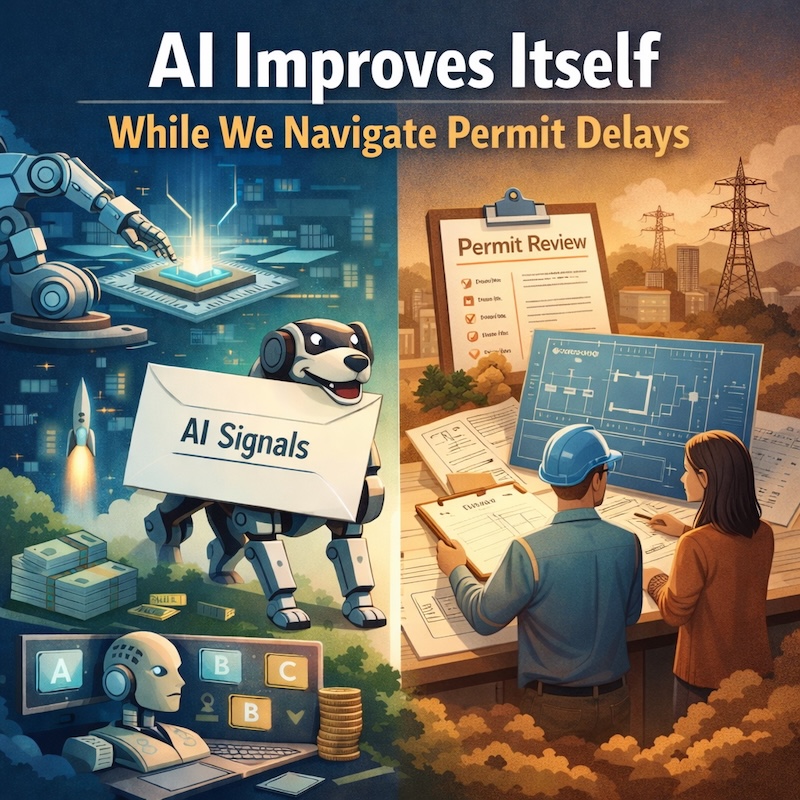
But the friction from the real world is getting louder. Data centre projects are stalling in permit review. Communities are organising opposition. Microsoft is betting on speculative superconductor technology because conventional power delivery cannot scale. OpenAI changed its mission alignment team. ByteDance’s Seedance 2.0 launched with certain real-person content generation features limited or paused due to privacy and misuse concerns.
What stood out to me most is that the conversation is shifting. It is not only about model capability anymore. It is increasingly about who gets power, who bears costs, and who keeps control. These are harder questions, and they do not have clean technical solutions.
1. Inference Infrastructure Funding Momentum Continues
AI inference startup Modal Labs in talks to raise at $2.5B valuation, sources say
TechCrunch reports that Modal Labs is in talks for a new round at roughly a $2.5B valuation, and frames this as part of broader investor interest in inference-focused companies.
Why This Matters
The market signal is straightforward: inference is no longer a side layer. It is becoming the core battleground. Performance, latency, and cost discipline can define platform advantage now.
Here is the thing. If inference becomes the competitive layer, then model access alone will not differentiate platforms. Cost per token will. Latency predictability will. Infrastructure ownership will. This matters for developers making build-versus-buy decisions. Betting on a single model provider might be less strategic than investing in inference orchestration that can swap models as economics and capabilities shift. In 3–5 years, the teams who control efficient inference infrastructure may have more pricing power than the teams who train the models. That is worth thinking about.
2. OpenAI and Anthropic Ship Competing Models on the Same Day
A tale of two models, and the larger story for enterprise AI
Both OpenAI and Anthropic launched advanced coding models on the same day, with OpenAI releasing GPT-5.3-Codex and Anthropic shipping Claude Opus 4.6. OpenAI’s release is notable for being what the company calls its first model that was “instrumental in creating itself” by using early versions to debug its own training and manage deployment. Anthropic’s Opus 4.6 targets complex financial research and work-related functions.
Why This Matters
Simultaneous launches signal intensifying competition at the frontier. But there is something more interesting here. OpenAI claims this is their first model that was “instrumental in creating itself”, see Introducing GPT‑5.3‑Codex. That means models are starting to participate in their own improvement cycles. The implications are not small.
If models can meaningfully accelerate their own development, the gap between leading labs and everyone else may widen fast. The teams that can safely harness self-improving loops will compound their advantage. Those who cannot will face mounting pressure to skip safety validation steps just to keep pace.
Developers should watch whether this capability remains concentrated or diffuses. If only two or three labs can do this reliably in 2027, the market structure starts to look less like open competition and more like a natural oligopoly. That is not a technical race. It is a market-structure shift.
3. OpenAI Reorganised Its Mission Alignment Function
OpenAI disbands mission alignment team
TechCrunch reports that OpenAI restructured its mission alignment team and reassigned team members, while former lead Josh Achiam moved into a chief futurist role.
Why This Matters
How AI labs structure internal governance work influences how clearly they communicate safety and societal goals. Team design choices are not just organisational details. They shape external trust. And trust matters when you are building systems this powerful.
When dedicated alignment teams dissolve or get redistributed, accountability becomes harder to trace. If safety functions are absorbed into product teams, they may become more responsive to shipping pressure. They may become less able to enforce hard stops. If this trajectory continues, this organisational choice could determine whether OpenAI maintains regulatory credibility or faces the kind of external oversight that slows deployment. Developers relying on OpenAI’s API should pay attention. If internal governance weakens, API stability and terms-of-service predictability may become more volatile. Plan accordingly.
4. ByteDance Launches Seedance 2.0 Video Model With Strict Restrictions
Seedance 2.0 officially launched, drawing international attention
ByteDance officially launched Seedance 2.0 on February 12, its AI video-generation model, with strict restrictions on uploads that feature real-person images or videos. Early comparisons show visibly more realistic and richly detailed visuals than competitors like Google’s Genie 3, prompting Tesla CEO Elon Musk to comment that development is happening “too fast.”
Why This Matters
Video generation is crossing a quality threshold that makes deepfakes and authenticity concerns immediate. Not theoretical. Immediate. ByteDance is implementing upload restrictions from day one. That signals that governance design is becoming a launch requirement, not an afterthought.
This sets a precedent. If leading video models ship with built-in content restrictions, competitors will face pressure to match or exceed those controls. Otherwise, they risk being blocked by regulators and platform providers. Developers building on video APIs should expect stricter usage policies, more aggressive content moderation, and higher compliance costs.
In several years, unrestricted video generation may only be available through self-hosted open models. And even those may face legal liability that makes deployment risky. The cost is borne by legitimate creative use cases that get caught in overly broad filters. That is the tradeoff nobody wants to talk about.
5. Data Centre Buildout Is Meeting Community Pushback
Power, Pollution, and Protests: The Growing Revolt Against AI Data Centers
TechRepublic describes growing local opposition to AI data centre projects, highlighting concerns around power demand, environmental impact, and public trust.
Why This Matters
Compute expansion depends on social license as much as on capital. If communities and regulators resist projects, deployment timelines and economics can shift quickly. This is not hypothetical. It is happening now.
The pattern is clear. Data centres are becoming as politically contested as nuclear plants or highways. If local opposition becomes organised and effective, the cost of siting new capacity will rise sharply. Not just in money. In time.
A two-year permitting delay can render a data centre economically obsolete before it even opens.
In the near future, AI companies may face a choice. Pay premium prices for capacity in jurisdictions that welcome them. Or invest heavily in community relations and benefit-sharing to secure local approval. The winners will be the companies and regions that figure out credible power-sharing arrangements early. The losers will be communities that reject projects without securing alternatives, and companies that assume infrastructure is purely a capital problem. It is not.
6. Microsoft Is Exploring Superconductors for Data Centre Power Delivery
Microsoft touts far-off high-temperature superconducting tech for datacenter efficiency
The Register reports Microsoft is evaluating high-temperature superconducting power delivery for future data centre efficiency, while noting the technology is still early and not yet at a broad deployment scale.
Why This Matters
Power architecture is now a strategic variable in AI. Even long-horizon bets matter because energy delivery is becoming a first-order limiter for compute growth. This is important to understand.
If high-temperature superconductors prove viable at scale, they could unlock data centre designs that are currently impossible. Higher density. Lower cooling costs. Radically improved power efficiency. But the timeline matters. If this technology is 10+ years out, it will not solve the capacity crunch happening right now. The companies investing in these long bets are signaling that they expect today’s power constraints to persist and tighten. Developers should read this as a warning. If even Microsoft is exploring speculative physics solutions, conventional power delivery is not going to get cheaper or more abundant. Plan accordingly.
7. Perplexity Launches Model Council System
Perplexity launched Model Council, a system that runs multiple frontier AI models including Claude, GPT-5.2, and Gemini in parallel to generate unified, cross-validated answers. This approach moves away from relying on single models, essentially creating an AI committee that cross-checks each other’s work.
Why This Matters
Multi-model orchestration is becoming a practical strategy for improving reliability and reducing hallucination errors. This shift suggests that production AI systems may increasingly depend on ensemble architectures rather than betting on a single model provider. The economics here are interesting.
If ensemble approaches become the standard for high-stakes applications, then API design and cost structures will need to change. Running three models in parallel is expensive today. But if it becomes the baseline for trustworthy outputs, the cost gets absorbed into the product. This benefits users who get more reliable answers. It penalises single-model providers who cannot compete on accuracy alone.
Developers should watch whether Model Council-style architectures diffuse beyond search. If legal, medical, and financial applications start requiring multi-model consensus, vendor lock-in risk drops and model commoditization accelerates. In a couple of years, differentiation may shift from “which model is best” to “which orchestration layer is fastest and cheapest.” That changes the game entirely.
8. Cisco Is Positioning Collaboration Hardware as AI Edge Infrastructure
Cisco Turns Collaboration Devices Into AI-Powered Infrastructure
TechRepublic covers Cisco’s new collaboration endpoints and frames them as managed AI-capable infrastructure, not just peripherals.
Why This Matters
AI capabilities are spreading from centralised cloud stacks to everyday enterprise endpoints. That shift changes how IT teams think about fleet management, security boundaries, and the value of edge computing. The implications are not small.
If collaboration devices become AI-capable infrastructure rather than dumb terminals, then security and compliance models need to change. Edge AI means local processing. That means sensitive data may never leave the building. Good for privacy. Harder to audit and patch.
Very soon, enterprises may face a choice. Accept the security and management complexity of distributed AI endpoints. Or lock down to cloud-only models, sacrificing latency and privacy benefits. The companies that figure out edge AI governance early will have a structural advantage. The cost is borne by IT teams who now have to manage AI models the same way they manage operating systems. Versioning. Rollback. Incident response. The whole stack. That is not trivial.
Apps & Tool Updates
1. Threads Introduces “Dear Algo” Feed Controls
Threads' new 'Dear Algo' AI feature lets you personalize your feed
TechCrunch reports that Threads launched an AI-powered control that lets people temporarily tune what they want to see more or less of in their feed.
Why This Matters
Consumer AI is moving toward explicit preference controls. That can improve user trust and reduce the feeling that recommendation systems are opaque and fixed. But there are tradeoffs here.
If users can reliably tune their feeds, platforms lose some of their ability to optimise purely for engagement. Better user experience and trust. Potentially lower session times and ad exposure. The platforms that get this balance right will retain users who might otherwise leave for less algorithmic alternatives.
We might expect that explicit preference controls may become a regulatory requirement rather than a competitive feature. Europe is already moving in that direction. Developers building recommendation systems should pay attention. The era of invisible, uncontrollable algorithms is ending. The cost is complexity. Giving users control means building interfaces that are both powerful and comprehensible. That is harder than it sounds.
2. Nemotron 3 Nano 30B Lands in SageMaker JumpStart

AWS announced NVIDIA Nemotron 3 Nano 30B availability in SageMaker JumpStart, including deployment examples via endpoint invocation and SDK workflows.
Why This Matters
Each managed-model addition reduces friction for teams that want to test new model families without having to stand up custom serving infrastructure from scratch. The impact is real.
The real shift here is time-to-experiment. If you can deploy a new model in minutes instead of days, the cost of trying alternatives drops to nearly zero. This accelerates model commoditization. When switching costs are low, providers compete purely on performance and price. Not on integration complexity.
I think we might soon see managed platforms offering dozens of models with one-click deployment. The winners will be developers who build evaluation pipelines that can rapidly test and swap models as new options emerge. The losers will be teams that hard-code dependencies on specific model APIs and get locked in. Do not be the second group.
3. GLM-5 Joins the Open Model Competition
VentureBeat highlights z.ai’s GLM-5 release and reports competitive pricing positioning alongside claims of lower hallucination rates.
Why This Matters
The open model ecosystem is still accelerating. Faster release cycles and pricing pressure continue to narrow the gap between frontier incumbents and fast-moving challengers. This matters more than you might think.
If open models reach competitive quality at a fraction of the cost, the entire economics of AI shift. Proprietary model providers will face a choice. Cut prices and compress margins. Or differentiate on non-model factors like infrastructure, safety guarantees, and enterprise support. The teams that benefit most are developers who can run models locally or on cheaper infrastructure. They capture the cost savings directly. The teams that lose are those betting on sustained pricing power from model quality alone.
In the next few years, model quality may flatten across providers. The real competition will be on latency, reliability, and compliance tooling. Developers should build with the assumption that models will be cheap and abundant. Not scarce and expensive. That is the direction this is going.
Conclusion
This week’s pattern is clear. Three major model releases. A $2.5B inference infrastructure raise. Video AI is crossing into a territory that requires day-one governance. And yet: data centres stuck in permit battles, alignment teams restructured, communities pushing back on power demands.
AI momentum is not slowing. But its constraints are becoming more visible and more structural. The gap between what models can do (debug their own code, generate photorealistic video, run multi-model consensus checks) and what infrastructure can support (build data centres, deliver power, maintain social license) is widening.
Which signal feels most relevant where you work right now? The self-improving models? The $2.5B that cannot buy a permit? The video AI that ships with restrictions? I would love to hear what you are seeing.