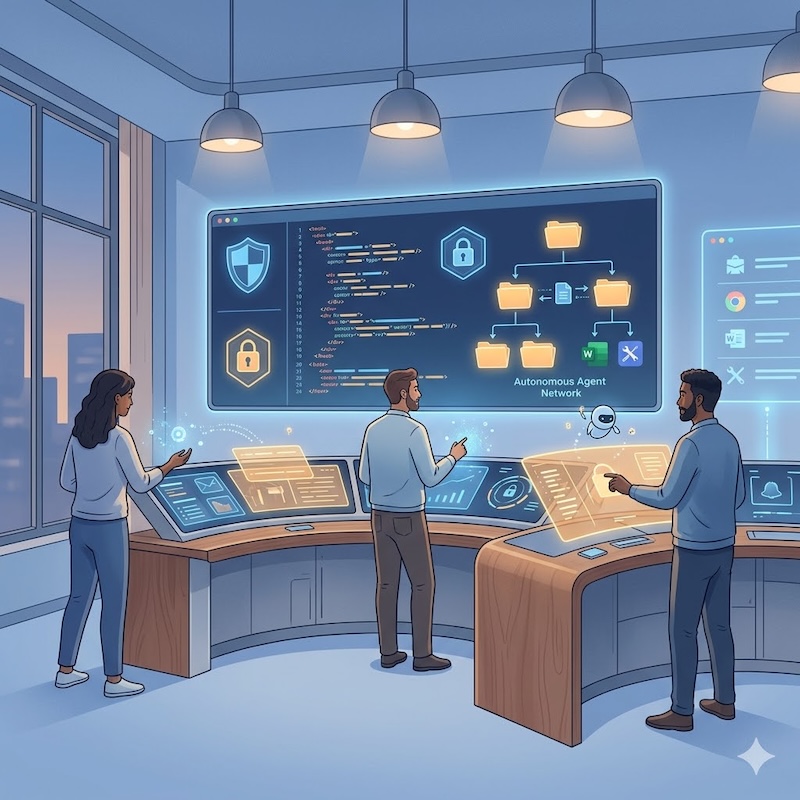
AI Agent Infrastructure, Cyber-Capable Models, and Safety Controls: The Week in Context
Hi! Hope you are having a good week. I just returned from vacation — rested, curious, and apparently right on time, because this week’s stories were too good to miss.
Something shifted this week. It was not about which model scored highest. It was about who gets access, under what rules, and what happens when those rules are tested.
Anthropic wrapped a stronger Opus in cyber guardrails. OpenAI handed more powerful tools to verified defenders and pushed agents into real execution environments. Microsoft drove image generation further down the cost curve. And central banks issued warnings — in public, seriously.
The stack got stronger. The world got serious. That is the real story this week.
In this issue:
- Claude Opus 4.7 — Better Coding, Stronger Vision, Tighter Cyber Guardrails
- OpenAI’s GPT-5.4-Cyber — Cyber Capability Becomes a Special Access Tier
- OpenAI’s Agents SDK — Agents Move Toward Real Execution Environments
- Codex for (Almost) Everything — Broader Software-Work Automation
- Microsoft MAI-Image-2-Efficient — Image Generation Moves Down the Cost Curve
- Regulatory and Financial-Sector Response to AI Cyber Risk
Model Releases and Agent Infrastructure
1. Claude Opus 4.7 — better coding, stronger vision, tighter cyber guardrails
Introducing Claude Opus 4.7 — Anthropic
Anthropic rolls out Claude Opus 4.7 as Mythos stays under lock and key — CNBC
Anthropic released Claude Opus 4.7 on April 16, 2026. Claude Opus 4.7 is Anthropic’s flagship large language model release, positioned as a notable improvement over Opus 4.6 in advanced software engineering, especially on difficult tasks, and built to handle complex, long-running work with more rigor and consistency. The model also has better vision, with support for higher-resolution image inputs. Pricing is unchanged from Opus 4.6 at $5 per million input tokens and $25 per million output tokens, and Opus 4.7 is available across Claude products, the API, Amazon Bedrock, Google Cloud Vertex AI, and Microsoft Foundry.
Anthropic also introduced new control surfaces around Opus 4.7. The release includes task budgets in public beta, a new xhigh effort level, and /ultrareview, a multi-agent code review tool. Anthropic says the updated tokeniser may use around 1.0x to 1.35x the tokens of Opus 4.6, depending on content, which developers will need to account for — particularly in vision-heavy agentic workflows.
What makes this launch more interesting than a normal model refresh is the framing. Anthropic explicitly says Opus 4.7 is the first less-capable model on which it is testing new cyber safeguards before any broader release of Mythos-class systems. Notably, Anthropic also says it experimented with efforts to deliberately reduce Opus 4.7’s cyber capabilities during training — a sign that safety shaping is now happening at the model level, not just at the policy layer. Anthropic says it added protections that automatically detect and block requests indicating prohibited or high-risk cybersecurity uses, and it launched a Cyber Verification Program for legitimate security professionals who want to use the model for vulnerability research, penetration testing, and red-teaming.
Why This Matters
Anthropic is no longer treating capability and deployment policy as separate topics. Frontier launches may increasingly come bundled with narrower access rules, verification layers, and explicit operational safeguards. That is a meaningful change in how these systems reach the world.
2. OpenAI’s GPT-5.4-Cyber — cyber capability is becoming a special access tier
Trusted access for the next era of cyber defense — OpenAI
On April 14, OpenAI expanded its Trusted Access for Cyber (TAC) program and introduced GPT-5.4-Cyber, a version of GPT-5.4 tuned for defensive cybersecurity work. OpenAI says the expansion scales TAC to thousands of verified individual defenders and hundreds of teams responsible for defending critical software. Individual users can verify identity through chatgpt.com/cyber, while enterprises apply through an OpenAI representative.
OpenAI says GPT-5.4-Cyber lowers the refusal boundary for legitimate cybersecurity work and enables advanced defensive workflows, including binary reverse engineering, allowing security professionals to analyse compiled software for malware potential, vulnerabilities, and robustness without needing source code access. Because the model is more permissive, OpenAI says rollout is starting with vetted vendors, organisations, and researchers.
The strategic signal here is clear: cyber capability is starting to become its own deployment class. Instead of a single general model with one universal policy layer, companies are beginning to carve out special-access variants for verified users with defensible purposes.
Why This Matters
The next AI differentiation may not just be “which model is smarter,” but “which users can access which capabilities under what verification regime.” In cyber, at least, the future increasingly looks tiered.
3. OpenAI’s Agents SDK — agents are moving from demos toward real execution environments
The next evolution of the Agents SDK — OpenAI
On April 15, OpenAI updated its Agents SDK. The Agents SDK is OpenAI’s developer framework for building AI agents, and the update adds a more capable harness with native sandbox execution, letting agents inspect files, run commands, edit code, and work on longer-horizon tasks inside controlled environments. The new harness and sandbox capabilities are launching first in Python, with TypeScript support planned for a future release.
The important change is not just “more tools.” It is the shape of the infrastructure. OpenAI says the SDK now includes configurable memory, sandbox-aware orchestration, filesystem tools, support for MCP, AGENTS.md, and apply_patch, plus a Manifest abstraction for describing an agent workspace. Developers can mount local files, define output directories, and connect storage providers including AWS S3, Google Cloud Storage, Azure Blob Storage, and Cloudflare R2. OpenAI also says built-in snapshotting and rehydration allow an agent run to continue from the last checkpoint if the original environment fails or expires.
Developers can bring their own sandbox or use built-in support for Blaxel, Cloudflare, Daytona, E2B, Modal, Runloop, and Vercel. That pushes the agent conversation one level down the stack: away from prompt glue and toward reusable execution environments with clearer operational boundaries.
Why This Matters
If you are building agents, the hard part is rarely just “call the model.” It is memory, files, execution, safety boundaries, and orchestration over time. This release is a sign that agent infrastructure is maturing into a real platform layer.
4. Codex for (almost) everything — OpenAI is turning coding assistance into broader software-work automation
Codex for (almost) everything — OpenAI
On April 16, OpenAI shipped a major update to Codex, its AI coding agent. OpenAI says the release makes Codex a more powerful partner for the more than 3 million developers who use it every week across the software development lifecycle. The update adds computer use, an in-app browser, image generation, and more than 90 additional plugins spanning skills, app integrations, and MCP servers.
Two features stand out for longer-horizon work. OpenAI says automations can now reuse conversation threads, preserve context, and continue work later. OpenAI also released a preview of memory, which allows Codex to remember useful context from previous experience, including preferences, corrections, and information that took time to gather. OpenAI says computer use is initially available on macOS, with rollout to EU and UK users soon, and that memory and related personalisation features will also reach Enterprise, Edu, EU, and UK users later.
Codex is starting to look less like a coding assistant and more like a broader software-work operating layer as a result of this update. Codex still sits within developer workflows, but it is clearly moving toward something more persistent, more integrated, and better at carrying work forward over time.
Why This Matters
This is one of the clearest signs yet that the developer-facing AI race is moving from “help me write code” to “help me keep the whole workflow moving.” That is a much bigger category.
Cost and Deployment
5. Microsoft MAI-Image-2-Efficient — image generation is moving down the cost curve
Introducing MAI-Image-2-Efficient — Microsoft
On April 14, Microsoft launched MAI-Image-2-Efficient, a production-oriented variant of MAI-Image-2. Microsoft says the model is available in Microsoft Foundry and MAI Playground, is up to 22% faster, delivers 4x more efficiency than MAI-Image-2 when normalized by latency and GPU usage, and is priced at $5 per 1M text input tokens and $19.50 per 1M image output tokens. Microsoft also says it outpaces leading text-to-image competitors by 40% on average in its own latency testing.
Microsoft frames the efficient version as the production workhorse to MAI-Image-2’s higher-fidelity tier. The company says MAI-Image-2-Efficient is built for speed, cost control, and production workflows, including product shots, marketing creative, UI mockups, branded assets, and batch pipelines. Microsoft also notes that the flagship MAI-Image-2 (not the Efficient variant) previously debuted at #3 on the Arena.ai leaderboard for image model families — making the Efficient version a production-optimised derivative of an already highly rated model.
This launch is a useful reminder that the image-model race is no longer only about peak quality. Vendors are also segmenting their systems into “best possible quality” and “cheap enough to disappear into production.”
Why This Matters
When image models get fast and cheap enough, workflows stop being AI demos and start becoming ordinary product features. That is a quiet but important shift.
Regulatory and Financial-Sector Response to AI Cyber Risk
Regulators are now reacting to AI models as live cyber infrastructure risks
ECB to quiz bankers about risks of Anthropic's new AI model — Reuters
BoE's Bailey sees major cybersecurity risks in new Anthropic model — Reuters
Bank of England says it is testing AI risks to financial system — Reuters
Our evaluation of Claude Mythos Preview's cyber capabilities — UK AI Security Institute
Bessent, Powell warned bank CEOs about Anthropic model risks — Reuters
The week’s biggest non-product signal may have been institutional. Reuters reported that ECB supervisors were preparing to ask eurozone banks about their preparedness for risks related to Anthropic’s Mythos, and that this would happen through the ECB’s regular dialogue with bank staff rather than an emergency executive meeting. Reuters also reported that the Bank of England is testing AI-related risks to the financial system through scenario analysis and simulations.
The regulatory reaction was not limited to Europe. Reuters also reported that US Treasury Secretary Scott Bessent and Federal Reserve Chair Jerome Powell convened the CEOs of Citigroup, Morgan Stanley, Bank of America, Wells Fargo, and Goldman Sachs at the Treasury to walk through the cyber risks posed by Mythos — one of the fastest cross-jurisdictional regulatory responses to a single AI model on record.
Reuters separately reported that Bank of England Governor Andrew Bailey warned Mythos may have found a way to “crack the whole cyber risk world open,” and that British officials were warning businesses about the threat of AI-enhanced cyberattacks. Technical evaluation by the UK AI Security Institute adds important nuance, however. While Mythos could not complete the operational-technology-focused Cooling Tower range, it was the first model to solve “The Last Ones” (TLO) — a 32-step simulated corporate network attack — succeeding in 3 out of 10 attempts. AISI also says its test environments lacked features common in real-world targets, including active defenders and defensive tooling.
Why This Matters
When central banks and regulators start treating a specific AI model as a live operational risk, the conversation has moved beyond benchmarks. That may be the clearest signal of the week.
What the Agent, Cyber, and Safety Stack Convergence Means Going Forward
Step back from these five signals, and the pattern is hard to miss.
The story this week was not “a smarter chatbot arrived.” More capable AI systems are colliding with the question of how they are governed, verified, sandboxed, and deployed. Anthropic released a stronger model but wrapped it in cyber guardrails and a new verification program. OpenAI widened access for defenders while hardening agent infrastructure and pushing Codex toward broader software-work automation. Microsoft kept driving the price-performance curve down for deployable image generation. And regulators treated AI cyber capability as a live operational issue, not a distant thought experiment.
This convergence represents the next phase of AI: less about one big launch, and more about a tightening stack — stronger models, narrower access, safer runtimes, and more serious institutions paying attention.
Did I miss a signal this week? Let me know — I’d love to hear your take.
References
- Introducing Claude Opus 4.7 — Anthropic
- Anthropic rolls out Claude Opus 4.7 as Mythos stays under lock and key — CNBC
- Trusted access for the next era of cyber defense — OpenAI
- The next evolution of the Agents SDK — OpenAI
- Codex for (almost) everything — OpenAI
- Introducing MAI-Image-2-Efficient — Microsoft
- ECB to quiz bankers about risks of Anthropic’s new AI model — Reuters
- BoE’s Bailey sees major cybersecurity risks in new Anthropic model — Reuters
- Bank of England says it is testing AI risks to financial system — Reuters
- Our evaluation of Claude Mythos Preview’s cyber capabilities — UK AI Security Institute
- Bessent, Powell warned bank CEOs about Anthropic model risks — Reuters
Stay Ahead in AI, Machine Learning & Python
No hype. Weekly notes on AI tools, Python, and what I'm actually building — plus seven free gifts, including Fantastic AI: The 2026 Toolkit and AI Coding Assistant Safety Card.
You're in
Check your inbox for Set a password to unlock articles if you want gated tutorials. Log in with the same email.