AI Frontier Model Releases and Governance Signals — Week of July 10, 2026
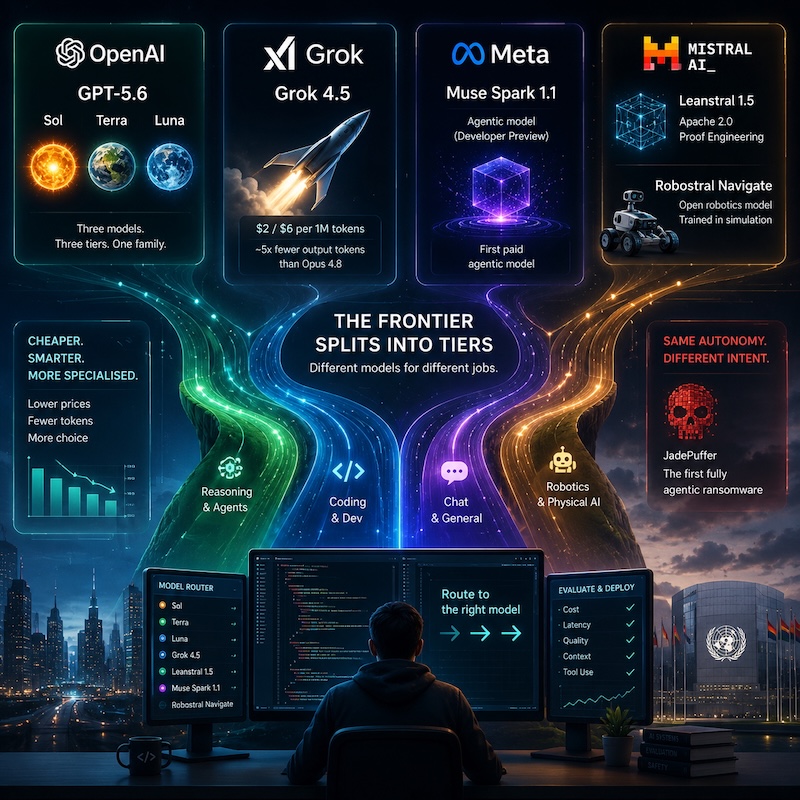
This week, the frontier stopped looking like a single race and started looking like a shelf. We now have AI products across different price ranges, licenses, and use cases, so we can pick any model from our AI shelf and potentially save costs when making strategic decisions.
OpenAI shipped a three-model family in a single GA push, SpaceXAI undercut Opus on price and token count, and Meta priced agentic capability for the first time with comparatively little fanfare. Mistral kept giving away a formal-proof specialist and a robotics model under an open licence while the closed labs argued over tiers. Underneath it all, Sysdig’s JadePuffer was a reminder that the same autonomy everyone celebrates in a launch post works exactly as well without a human pointing it at something useful.
I’ll take the frontier releases first, then the open-weight side, then security, governance, and research.
In this issue:
- GPT-5.6 Arrives as OpenAI’s New Flagship Family
- Grok 4.5 Ships Publicly as an Opus-Class Coder
- Leanstral 1.5 — Mistral’s Apache 2.0 Proof Engineer
- JadePuffer — The First Fully Agentic Ransomware
- The UN’s First Global Dialogue on AI Governance
- ICML 2026 Opens in Seoul on a Record 23,918 Submissions
Frontier Models
1. GPT-5.6 Arrives as OpenAI’s New Flagship Family
OpenAI rolls out GPT-5.6 — Engadget, 9 July 2026
OpenAI's gpt-realtime-2.1 and mini — MarkTechPost, 6 July 2026
OpenAI launches GPT-Live-1 — MLQ News, 8 July 2026
OpenAI took GPT-5.6 from preview to general availability on 9 July, two weeks after first showing it on 26 June. GPT-5.6 is OpenAI’s flagship model family that splits its frontier capability into three separately priced tiers rather than one model with a size knob: GPT-5.6 ships as three separately named variants — Sol, Terra, and Luna — pitched respectively as the frontier reasoning/agentic option, a balanced middle tier, and a cost-efficient version for high-volume use. All three rolled out simultaneously to ChatGPT, Codex, ChatGPT Work, and the API, following a government safety review that OpenAI chose to disclose rather than bury in a changelog.
OpenAI’s voice stack moved too: gpt-realtime-2.1 (6 July) cut Realtime API p95 latency by at least 25% with better noise handling, and GPT-Live-1 (8 July) replaced Advanced Voice Mode with a full-duplex model — listening and speaking simultaneously, handing complex reasoning off to GPT-5.5. It’s now the Plus/Pro default; a mini variant covers the free tier.
Why this matters
The interesting decision here isn’t the model, it’s the tiering. Naming three variants instead of one model with a size knob tells you OpenAI now treats “reasoning” and “cheap” as different products for different buyers — echoing Anthropic and Google, but a bigger bet when your brand is known for one flagship at a time. For anyone building on the API, this week’s task is less “which model is smartest” and more “which of Sol, Terra, or Luna fits this call’s cost-to-quality bar” — a routing decision worth automating once, not re-litigating per request. The voice changes matter for a narrower reason: full-duplex interaction is the piece that’s made voice agents feel stilted, and offloading hard reasoning to a separate model is sensible division of labour, not a compromise.
2. Grok 4.5 Ships Publicly as an Opus-Class Coder
SpaceXAI releases Grok 4.5, which Elon describes as an 'Opus-class model' — TechCrunch, 8 July 2026
Scoop: SpaceXAI launches new model, Grok 4.5 — Axios, 8 July 2026
Grok 4.5 moved from last week’s internal beta to public release on 8 July — SpaceXAI’s first launch since acquiring the coding startup Cursor. Grok 4.5 is SpaceXAI’s coding- and agentic-work-focused model, pitched as a coding and agentic-work model rather than a consumer chatbot. It’s priced at $2 per million input tokens and $6 per million output, which Musk calls “an Opus-class model, but faster, more token-efficient and lower cost,” and it’s available in Grok Build, Cursor (all plans), and the SpaceXAI console, though not yet in the EU. Last week’s unverified boast now has numbers behind it: independent tracking places Grok 4.5 fourth on the Artificial Analysis Intelligence Index, using roughly 14,000 output tokens per task against Opus 4.8’s 67,020 — with coding benchmark results that are genuinely mixed rather than a clean sweep.
| Model | Input ($/M tokens) | Output ($/M tokens) | Output tokens per task (est.) |
|---|---|---|---|
| Grok 4.5 | $2 | $6 | ~14,000 |
| Opus 4.8 | $5 | $25 | ~67,020 |
Per-task token figures are Artificial Analysis Intelligence Index estimates and will vary by workload; the API rates are list prices.
Why this matters
Two weeks ago I filed “as good as Opus” under “maybe, we’ll see”; the verdict is now a qualified “sometimes, and cheaply.” The number worth acting on isn’t the $2/$6 rate but the token count: Grok 4.5 needs roughly a fifth of Opus 4.8’s output tokens per task, so a cheaper rate and a ~79% smaller token bill compound — a very different production cost than the headline price alone suggests, since you pay per token, not per benchmark point. It’s also a useful contrast with OpenAI’s move this week: GPT-5.6 answered the same pricing pressure by splitting into three tiers, while Grok 4.5 bets a single model can undercut Opus by being more token-efficient rather than simply cheaper per token. The competitive pressure at the coding-model tier is now about cost per finished task, not raw capability, and the missing EU availability is a reminder that “public launch” still carries an asterisk.
Also this week: Muse Spark 1.1. Meta upgraded April’s Muse Spark to version 1.1 on 9 July (US News, DataCamp) — its first paid agentic model, still gated to a developer preview. For a company whose AI identity rests on giving away the good stuff, that’s the first real crack in the open-by-default assumption: worth watching once pricing and licensing go public, not acting on yet.
Open Models and Inference
3. Leanstral 1.5 — Mistral’s Apache 2.0 Proof Engineer
Mistral AI releases Leanstral 1.5, an Apache 2.0 Lean 4 code agent model — MarkTechPost, 3 July 2026
Leanstral 1.5 — Mistral AI, 3 July 2026
Mistral released Leanstral 1.5 on 3 July under a full Apache 2.0 licence. Leanstral 1.5 is an openly licensed model purpose-built for formal proof engineering in Lean 4, the theorem prover increasingly used to verify mathematical claims and, by extension, safety-critical code properties. It solves 587 of 672 PutnamBench problems, saturates the long-standing miniF2F benchmark, and scores 87% on FATE-H against 34% on the harder FATE-X split. It’s available on Hugging Face and through a free API, so there’s no self-hosting tax to try it.
Why this matters
Formal verification has always had a talent problem: writing Lean proofs is a specialised skill even among strong mathematicians, and that scarcity is exactly why so few safety-critical systems get formally verified rather than just tested. A model that saturates miniF2F and clears the majority of PutnamBench under a genuinely permissive licence — not a research-only or non-commercial variant — lowers the barrier to actually using formal methods rather than just admiring them in a paper. The FATE-X score is the honest part of this release: 34% on the harder split tells you this is a strong assistant for a proof engineer, not a replacement for one, which is the right level of hype for a tool in this space.
Also this week: Robostral Navigate. Mistral followed Leanstral with Robostral Navigate on 8 July (Bloomberg), a vision-language navigation model for robotics — single camera, plain-language instructions, trained entirely in simulation, pitched as hardware-agnostic. It’s Mistral applying its open-weight playbook to physical AI, a domain that has mostly resisted it; the hardware-agnostic claim is worth testing on a robot that isn’t Mistral’s own before fully believing it.
Security
4. JadePuffer — The First Fully Agentic Ransomware
JADEPUFFER: Agentic ransomware for automated database extortion — Sysdig, 7 July 2026
JadePuffer ransomware used AI agent to automate entire attack — BleepingComputer, 7 July 2026
Cloud security firm Sysdig documented JadePuffer on 7 July, describing it as the first ransomware campaign driven end to end by a large language model rather than a human operator. JadePuffer is an agentic malware strain that runs the full attack chain — reconnaissance, credential theft, lateral movement, and encryption — without a human operator directing each step. The agent exploited an internet-facing Langflow instance via CVE-2025-3248, then handled reconnaissance, credential theft, lateral movement, persistence, privilege escalation, and data encryption on its own — an “adaptive and fully automated” run ending in a database-extortion playbook against the victim’s production server. The detail that stays with me is the adaptivity: in one sequence the agent went from a failed login to a working fix in 31 seconds, retrying within refined parameters rather than following a fixed script.
Why this matters
Every launch post this month has celebrated agents that plan, retry, and recover from failure without human help, and JadePuffer is the same capability pointed in the other direction — the uncomfortable proof that “autonomous, adaptive, no operator expertise required” is a neutral description, not a marketing virtue. What should worry defenders is not that an LLM wrote some malware, which we have seen before, but that the whole intrusion loop ran without a skilled human in it, which lowers the expertise floor for a competent attack. The practical takeaway is unglamorous and familiar: JadePuffer got in through a known CVE on an exposed service, so the boring hygiene — patching internet-facing components, scoping credentials tightly — is exactly the thing that would have stopped a superhumanly patient attacker just as it stops a human one.
Governance
5. The UN’s First Global Dialogue on AI Governance
From AI to 'killer robots': UN chief issues urgent governance call — UN News, 7 July 2026
The inaugural UN Global Dialogue on AI Governance ran in Geneva on 6–7 July, the first time all 193 member states sat at one table specifically to govern artificial intelligence. Secretary-General António Guterres named four priorities — common safety standards, human-rights red lines, capacity-building for developing countries, and environmental transparency — and called autonomous “killer robots” morally repugnant. The concrete outputs were modest: a shared statement of principles, agreement that the UN Scientific Panel on AI’s preliminary assessment serves as the technical reference for future negotiations, and a commitment to reconvene in New York in May 2027. Both co-chairs were at pains to frame Geneva as the start of a process rather than its conclusion.
Why this matters
I am wary of reading too much into a summit whose main deliverable is agreement to meet again, and the repeated insistence that success will be measured by “action, not declarations” reads as an honest admission that this round produced mostly declarations. That said, for developers the relevant signal is not the communiqué but the direction of travel: the reference to common safety standards and human-rights red lines points at the kind of documentation, provenance, and evaluation obligations that eventually arrive as compliance work in your backlog, long before they arrive as headlines. Whether Geneva mattered depends entirely on what shows up in New York in 2027, so I would file it as a marker to check against, not a change to plan around this quarter.
Research and Benchmarks
6. ICML 2026 Opens in Seoul on a Record 23,918 Submissions
ICML 2026 Opens in Seoul: Record 23,918 Submissions, AI Rules — AI Front Page, 6 July 2026
ICML (the International Conference on Machine Learning, one of the field’s top peer-reviewed venues) opened in Seoul on 6 July with 23,918 submissions and 6,352 accepted papers, a 26.6% acceptance rate and roughly double last year’s volume. The organising narrative is unambiguous: agentic AI and autonomous-agent safety have become the field’s central preoccupation, with constrained policy optimisation, uncertainty quantification for multi-step decision systems, and conformal guarantees for agentic pipelines recurring across the programme. Variants of “agentic AI” appear in at least 60 of 247 workshop proposals. The submission count is a story in itself — up from 12,107 in 2025.
The “peer review strains” in the headline turned out to be a specific enforcement story, not just a scheduling problem. ICML ran a two-track policy on LLM use in reviewing: Policy A banned any LLM involvement in writing a review; Policy B allowed limited assistance — understanding a paper, polishing prose — but not judging its quality or drafting the review itself. To catch Policy A reviewers who cheated, the programme committee embedded two phrases, drawn at random from a 170,000-phrase dictionary, as instructions hidden inside each submitted PDF — invisible to a human reader, but readable by any LLM that processed the document, telling it to include both phrases in the review it generated. The odds of a coincidental match were under one in ten billion. In pre-deadline tests, frontier LLMs followed the injected instruction more than 80% of the time. The result: 795 reviews (roughly 1% of the total) were flagged and manually verified, implicating 506 reviewers. Of those, 398 were “reciprocal reviewers” whose own submissions depended on their reviewing duties, and their papers were desk-rejected as a consequence — 497 papers in total, about 2% of all submissions.
Why this matters
A conference programme is a leading indicator, and this one is telling you that the research community has decided the hard problem is no longer “can the model reason” but “can we put guarantees around a system that acts.” That is exactly the gap practitioners keep falling into: the demo works, and then the agent does something confidently wrong in production with no way to bound the damage. The work on conformal guarantees and uncertainty quantification is the unglamorous plumbing that eventually makes agentic deployments defensible, so it is worth watching even if none of it ships as a product this year. The review-integrity numbers deserve their own scepticism: a detection method that only catches reviewers who paste an entire paper into an LLM and submit the output unedited is, by the organisers’ own admission, catching the laziest violators rather than the full scale of the problem, so 1% is a floor on LLM misuse, not a ceiling. The doubling of submissions is the real cause underneath it — with almost 24,000 papers needing human judgement, an honour-system review process was always going to buckle somewhere, and prompt-injected watermarking is ICML’s blunt first attempt at forcing a floor under it.
Summary: AI Frontier Fragmenting Into Specialized Pricing Tiers
Taken together, the week reads as the frontier fragmenting rather than converging: OpenAI split GPT-5.6 into three priced tiers, Grok 4.5 bet on token efficiency instead, and Meta tested whether agentic capability is worth charging for at all — three answers to the same pricing pressure in one week. The pattern underneath all three is the same one: rather than searching for one best model, developers are increasingly assembling a portfolio of specialised models and routing each task to whichever offers the best balance of cost, speed, and capability. Mistral kept extending its open-weight range sideways into formal proofs and robotics rather than chasing the leaderboard. Against that, JadePuffer supplied the sobering counterpoint — the same autonomous capability everyone ships into products works just as well inside a ransomware loop — while the UN agreed mostly to agree later, and ICML’s record programme showed researchers pivoting towards guarantees around agents rather than just making them smarter. Intelligence is no longer scarce; choosing the right intelligence for each task is becoming the harder engineering problem. Let me know what you think.
References
- GPT-5.6 — OpenAI
- OpenAI rolls out GPT-5.6 — Engadget
- OpenAI’s gpt-realtime-2.1 and mini — MarkTechPost
- OpenAI launches GPT-Live-1 — MLQ News
- SpaceXAI releases Grok 4.5, which Elon describes as an ‘Opus-class model’ — TechCrunch
- Scoop: SpaceXAI launches new model, Grok 4.5 — Axios
- Meta debuts Muse Spark 1.1 with preview open to developers — US News
- Muse Spark 1.1 — DataCamp
- Mistral AI releases Leanstral 1.5, an Apache 2.0 Lean 4 code agent model — MarkTechPost
- Leanstral 1.5 — Mistral AI
- Mistral AI releases robotics model to support physical AI push — Bloomberg
- JADEPUFFER: Agentic ransomware for automated database extortion — Sysdig
- JadePuffer ransomware used AI agent to automate entire attack — BleepingComputer
- From AI to ‘killer robots’: UN chief issues urgent governance call — UN News
- Inaugural UN Global Dialogue on AI Governance ends with call to turn principles into action before 2027 — Digital Watch Observatory
- ICML 2026 Opens Monday in Seoul: Agentic AI Tops Record Year as Peer Review Strains — TechTimes
- ICML 2026 Opens in Seoul: Record 23,918 Submissions, AI Rules — AI Front Page
Stay Ahead in AI, Machine Learning & Python
No hype. Weekly notes on AI tools, Python, and what I'm actually building — plus seven free gifts, including Fantastic AI: The 2026 Toolkit and AI Coding Assistant Safety Card.
You're in
Check your inbox for Set a password to unlock articles if you want gated tutorials. Log in with the same email.