Introduction
AI news moves fast, but the cast changes slowly. Someone trains the models, someone makes the chips they run on, and a handful of ideas tie it all together. I put them on one page: the AI Map. It is for you if headlines about agents, MCP or quantisation feel like a wall of acronyms and you want to know where to start.
What is on the map
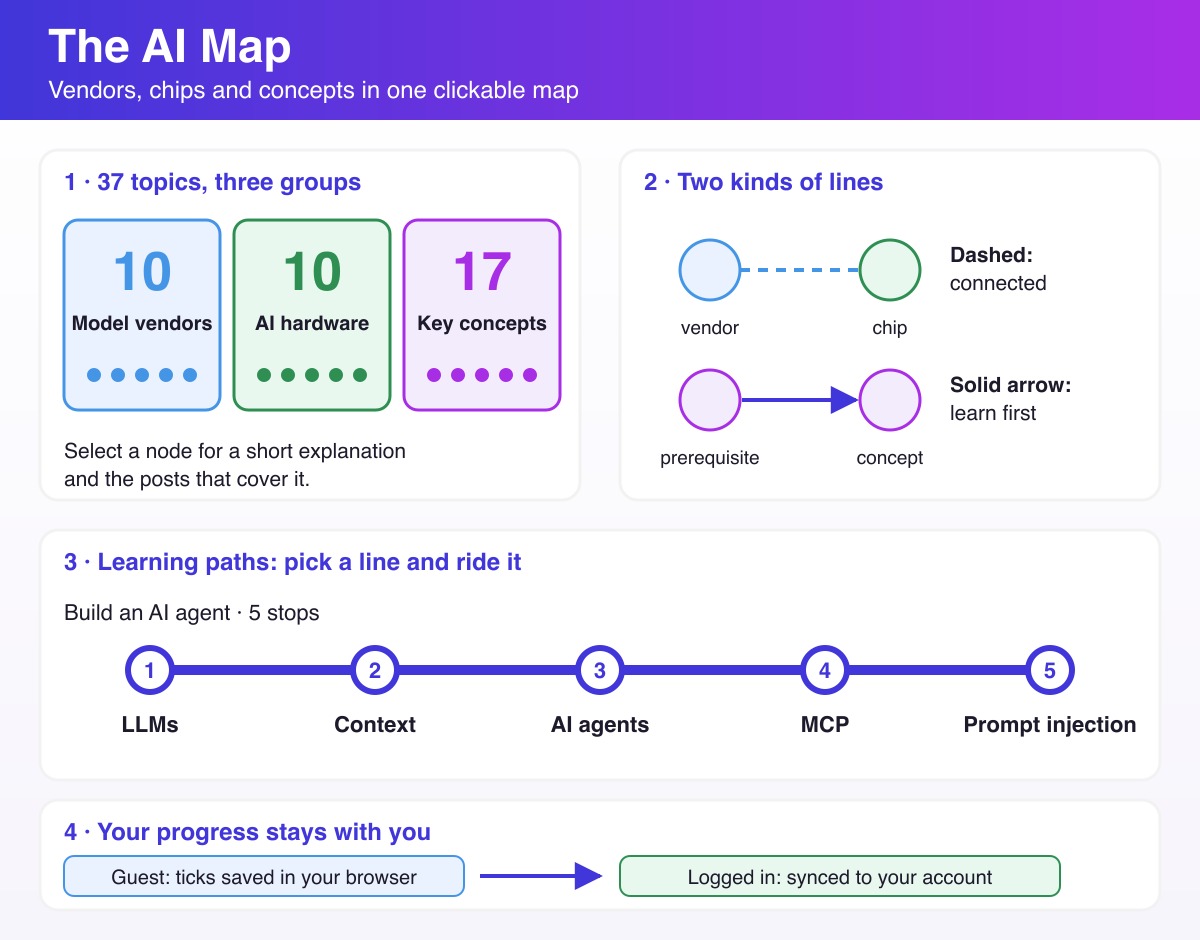
There are 37 topics in three groups:
- 10 model vendors, the labs that train foundation models.
- 10 hardware makers, the chips and foundries that decide how fast models train and where they can run.
- 17 key concepts, from large language models and context to agents, MCP and prompt injection.
Select any node and you get a short explanation plus the posts on this blog that cover it. Nodes without posts are topics I have not written about yet. I left them visible on purpose.
Two kinds of lines
Dashed lines show connections, for example between a vendor and the chips it depends on. Solid arrows show what to learn first: select a concept and its prerequisites point into it. So you do not need to guess whether to read about MCP before or after agents. The arrows tell you.
If you prefer text to diagrams, there is a list view and a search box.
Learning paths
Three short routes take you through the concepts:
- Build an AI agent (5 stops): connect a model to tools and context, then keep its permissions under control.
- Run AI on your own machine (6 stops): open-weight models, quantisation and private retrieval on local hardware.
- Make AI more trustworthy (7 stops): grounding, tool access and the risks that come with them, then the wider rules.
Choose Show on map and the path appears as numbered stops. Mark a topic as done and the page shows what comes next.
Think of a metro map. You do not need to visit every station. You pick a line and ride it. On a phone, the paths even turn into a metro line.
Your progress stays with you
You do not need an account. As a guest, your ticks are saved in your browser. If you log in, they sync to your account, so the map remembers you on another device too.
Final thoughts
The map will keep growing as I write more. I would love to know which path you try first and which topic is missing. You can tell me through the contact page.
References
- The AI Map, the interactive page
- A Gentle Introduction to MCP
- Large Language Models and Generative AI
Stay Ahead in AI, Machine Learning & Python
No hype. Weekly notes on AI tools, Python, and what I'm actually building — plus seven free gifts, including Fantastic AI: The 2026 Toolkit and Python Virtual Environments.
You're in
Check your inbox for Set a password to unlock articles if you want gated tutorials. Log in with the same email.