Gemini 3, Antigravity, and Humanity-Centred AI: This Week’s Signals
This week wasn’t just about new models. It was about growing up.
Google and OpenAI delivered the expected fireworks: Gemini 3 refined the “Mixture-of-Experts” architecture for massive scale, and Project Antigravity killed the text editor in favour of agent orchestration.
But the real signal didn’t come from a server farm. It came from the “adults in the room.” The WHO issued a strict mandate that “Humanity must hold the pen,” citing dangerous error rates in AI diagnosis. Ernst & Young demanded we start measuring the energy cost of intelligence (~1Wh per query). And on 60 Minutes, Anthropic’s CEO publicly questioned the unchecked power of unelected tech leaders—including himself.
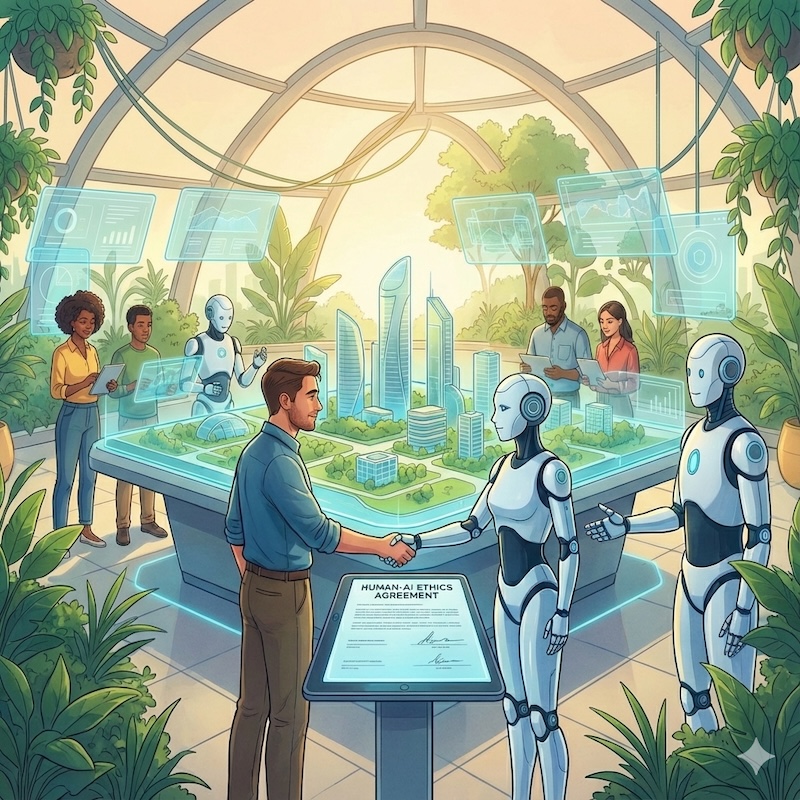
We are shifting from “look at this cool demo” to “how do we actually live with this?” The era of moving fast and breaking things is over. Welcome to the era of integration.
If you're still waiting for AI winter, I have bad news: we're in AI summer, and nobody brought sunscreen.
1. Google Gemini 3 + “Antigravity”: The Death of the Text Editor?
Google launched Gemini 3 on Tuesday. The model itself is impressive, but the real story is the environment it lives in. Project Antigravity (available now) doesn’t just want to help you write code; it wants to manage the team that writes it for you.
The Model: Gemini 3
The Gemini 3 Model Card confirms the architecture is a highly refined “Sparse Mixture-of-Experts (MoE) Transformer” [1].
Google DeepMind’s Gemini 3 has marked a pivotal moment in artificial general intelligence research by achieving a significant leap on the ARC-AGI-2 Semi-Private Evaluation [10]. This benchmark prevents dataset contamination, forcing the model to rely entirely on fluid intelligence.
Gemini 3 Architecture Profile
| Feature | Specification | Technical Impact |
|---|---|---|
| Topology | Sparse MoE Transformer | Routes queries to specialised sub-networks, massively reducing active inference parameters while preserving scale. |
| ARC-AGI-2 Score | 45.1% | Demonstrates fluid induction of abstract rules (visual program synthesis) without prior dataset exposure. |
| “Deep Think” | System 2 Reasoning Layer | Generates invisible “thought blocks” to plan, critique, and verify reasoning before outputting, allowing real-time self-correction. |
| Context Window | 1.04M (Production) / 10M (Research) | Capable of ingesting entire multirepository codebases, though commercially capped to guarantee reliability. |
Mixture-of-Experts architecture represents a categorical shift from monolithic dense transformers toward sparse, specialized computation that scales capability without proportionally scaling inference cost.
The Tool: “Antigravity”
Here is where things get wild. “Antigravity” is not just another code completion tool. It is an “agent-first” integrated development environment (IDE) [5].
IDE Paradigm Shift: Antigravity
Antigravity fundamentally changes the job description of a software engineer by bifurcating the development environment:
| Workspace Layer | Function | Developer Role |
|---|---|---|
| Editor View | Familiar, syntax-level text editing (similar to VS Code). | The Bricklayer: Getting hands dirty, manually patching edge cases. |
| Manager View (Surface) | Agent orchestration dashboard. | The Foreman: Spinning up parallel agents for SQL, CSS, and documentation. |
| Artifacts Engine | Generates verifiable proof of work (e.g., recorded browser sessions). | The Inspector: Reviewing execution evidence and “Vibe Coding” intent, rather than raw syntax. |
Because the agent has full control over the terminal and browser, it spins up the server, opens a browser, and records a video of itself testing the feature [6]. You don’t just review the code; you review the evidence.
2. WHO & EY: Humanity-Centred AI is No Longer Optional
Two prominent voices—the World Health Organisation and Ernst & Young—drew a line in the sand this week.
WHO’s Human-in-the-Loop Mandate for Medical AI
The WHO warned that Europe is facing a pivotal moment in health AI. Dr. Hans Henri P. Kluge explicitly stated, “Humanity must hold the pen,” demanding strict “human-in-the-loop” protocols for medical AI [7].
Human-in-the-loop oversight is a categorical requirement for medical AI systems, not an optional safety feature.
Think about what this means. When AI enters healthcare, the metrics change from “latency” and “tokens per second” to actual human lives.
If your AI makes a mistake in production, someone might lose their job. If hospital AI makes a mistake in production, someone might lose their life. Suddenly those unit tests seem pretty important, right?
EY’s Sustainability Framework
Ernst & Young released a framework for “Sustainable AI,” focusing on the energy cost per token. A single complex reasoning query can now consume nearly 1 Wh of energy. EY is urging the industry to shift from “pilots to performance”—counting the cost not just in dollars, but in grid impact.
The Amodei Warning: AI Industry Power Concentration Concerns
Here is the thing about warnings: they hit differently when they come from inside the house.
Anthropic’s CEO Dario Amodei expressed “deep discomfort” with the concentration of power in the hands of a few AI labs during a candid interview on 60 Minutes this week [13].
Dario Amodei’s Statement on AI Industry Power Concentration
“I think I’m deeply uncomfortable with these decisions being made by a few companies… like who elected you and Sam Altman? No one.”
Let that sink in. The CEO of one of the leading AI companies is publicly questioning the legitimacy of his own industry’s power structure. This is an insider raising alarm bells.
Human-AI Role Divergence: Architects Versus Bricklayers in Software Development
This week wasn’t just about better benchmarks; it was about a fundamental shift in job descriptions.
With Gemini 3 and Antigravity, Google is handing us tools that are no longer just assistants—they are labourers. They can plan, execute, and verify. Simultaneously, the WHO and Amodei are reminding us that unsupervised labour is a liability.
We are witnessing a structural divergence in how software and systems are built:
The Role Evolution Matrix
| Entity | New Responsibility | Focus Area |
|---|---|---|
| The AI | The Bricklayer | Handling syntax generation, CSS refactoring, and exhaustive unit test scaffolding. |
| The Human | The Architect & Inspector | Defining system intent, auditing energy/compute costs, and signing off on mission-critical safety (Human-in-the-Loop). |
The “Wild West” era of moving fast and breaking things is officially over. The era of integration has begun. The tools just got significantly sharper—the question now is, do you have the discipline to wield them?
Did you like this post? Please let me know if you have any comments or suggestions.
Ai posts (recent) that might be interesting for youReferences
- Gemini 3 Pro Model Card (PDF)
- Google Cloud Vertex AI - Gemini 3 Model Specs
- Google DeepMind: Long Context Window Research
- Gemini API Docs: Thinking Levels & Reasoning
- Google Developers Blog: Build with Antigravity
- Google Codelabs: Getting Started with Antigravity Artifacts
- WHO Statement: “Humanity must hold the pen”
- Optimization could cut the carbon footprint of AI training by up to 75% (University of Michigan/Patterson et al.)
- Anthropic CEO ‘Deeply Uncomfortable’ With Unelected Tech Elites (CBS News)
- the ARC Prize tweet with the ARC AGI-2 LEADERBOARD
Stay Ahead in AI, Machine Learning & Python
No hype. Weekly notes on AI tools, Python, and what I'm actually building — plus seven free gifts, including Fantastic AI: The 2026 Toolkit and Vibe Coding Checklist.
You're in
Check your inbox for Set a password to unlock articles if you want gated tutorials. Log in with the same email.