Elena' s AI Blog

OpenClaw Isn't a Chatbot Anymore. It's Infrastructure.

20 Feb 2026 (updated: 17 Aug 2026) / 19 minutes to read

Elena Daehnhardt


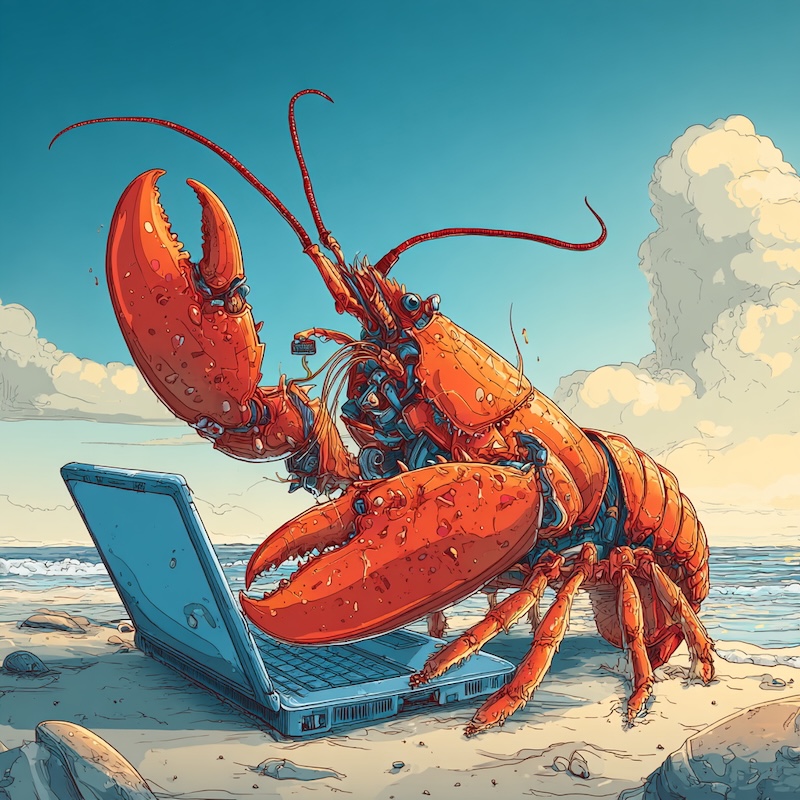
Midjourney 7.0, AI-art with the prompt: a gigantic lobster holds a laptop in its huge open claw, cartoon maritime and technology theme, HD


TL;DR:
  • OpenClaw transforms from a chatbot into live infrastructure the moment it connects to Slack and Gmail — and that shift demands a different deployment strategy entirely. Running it locally exposes SSH keys, credentials, and personal files to unnecessary risk. This post walks through a secure cloud architecture using VPS isolation and Docker, and explains why the deployment environment matters as much as the agent itself.

📚 This post is part of the "AI Safety" series

Series: AI Safety (Part 2 of 6)

Previous: Part 4 — The Digital Butler or Trojan Horse? A Privacy Playbook for Persistent AI Agents

Next: Part 3 — Using AI Code Assistants Safely

Before you install it locally, here are five entirely plausible ways your week could take an unexpected turn.

It looks harmless at first. You connect OpenClaw to your Gmail. You point it at Slack. You give it a few instructions and step away to make coffee.

But the moment it can read your inbox, post on your behalf, and call external APIs with your credentials — something changes.

The moment a system can act on your behalf with real credentials and persistent consequences, it becomes infrastructure. And infrastructure, as I have learned, has very different rules.

This post complements this week’s AI Signals, where I examine the broader capability, capital, and sovereign investment shifts shaping agentic AI at scale.

What Is OpenClaw, and Why Does Deployment Architecture Matter?

OpenClaw is an AI agent framework that connects to services like Slack and Gmail to monitor messages, draft replies, call external APIs, and execute automated workflows on a user’s behalf.

Unlike a chatbot, OpenClaw can monitor Slack channels, read and draft Gmail messages, call external APIs, execute structured workflows, and trigger automated actions. It is not answering questions. It is acting on your behalf, in your name, with your access.

The chatbot-versus-infrastructure distinction matters enormously — and most people miss it entirely until something goes wrong.

Five Ways a Local Install Can Ruin Your Week

Before we get to solutions, I think it is worth sitting with the risk for a moment. These are not hypothetical edge cases. They are entirely plausible consequences of a relaxed local setup.

1. The Accidental Mass Email You instruct OpenClaw to “send the project update to everyone on the list.” The agent interprets “the list” more broadly than intended and sends a half-finished internal draft — containing salary figures and performance notes — to every contact in your address book, including clients and a journalist you once emailed. By the time you notice, dozens of people have read it. There is no unsend. The professional fallout takes months to manage.

2. The Cascade Delete You ask the agent to “clean up old project folders from 2021.” It deletes an entire directory containing archived client contracts, tax documents, and the only copy of a completed but unsubmitted grant application. Because it used a shell command rather than the OS trash, there is no recovery path. You discover this weeks later, urgently searching for a document that no longer exists.

3. The Slack Impersonation A prompt injection attack arrives through an apparently innocent Slack message — carefully crafted to look like a system notification but containing hidden instructions telling the agent to forward all messages from the #finance channel to an external webhook. Because the agent is running with your own Slack credentials, the messages leave with full legitimacy. Weeks of sensitive financial planning discussions are exfiltrated before anyone notices.

4. The Credential Harvest OpenClaw’s working directory sits adjacent to your home folder, where a .env file and an unencrypted ~/.aws/credentials file quietly exist. A compromised third-party integration reads these files during a routine task execution. Your AWS keys — which control a production environment — are sent outbound in an API call disguised as telemetry. Your cloud bill the following morning shows £9,000 in compute charges from an unknown region.

5. The Relationship Grenade

OpenClaw, instructed to “keep people updated and be honest,” replies to your manager’s casual Friday check-in with a candid summary of how you truly feel about your role, your team, and the last reorg — things said only in private, to people you trusted. Monday morning brings no standup invite, just a calendar block titled “Quick chat — HR + your manager,” and the deeply unsettling realisation that you have no idea what else it may have sent, or to whom.

A solution? Approval Gate. For high-stakes actions (e.g., sending emails to managers), the architecture should ideally include a “Draft” status that requires a user click before the API call is finalised.

The Root Cause: No Separation

🔒 Subscribe to keep reading.

The Better Approach: Isolate the Agent

🔒 Subscribe to keep reading.

Cloud Architecture: A Secure Deployment Model

🔒 Subscribe to keep reading.

Threat Model: Think Like an Attacker

🔒 Subscribe to keep reading.

Multi-Agent Routing

🔒 Subscribe to keep reading.

Hosting Options

🔒 Subscribe to keep reading.

Agent Social Networks

🔒 Subscribe to keep reading.

OpenClaw Security Takeaways: Cloud Deployment vs. Local Install

🔒 Subscribe to keep reading.

Subscribe to unlock the full article ❤️

I keep most of the site completely open. A few unusually detailed tutorials need a free subscriber login so I can keep publishing this kind of work.

The form below signs you up for the newsletter. It does not log you into the app — log in afterwards (same email) to unlock this article and download your subscriber gifts. New subscribers get an inbox mail: Set a password to unlock articles.

desktop bg dark

About Elena

Elena, a PhD in Computer Science, simplifies AI concepts and helps you use machine learning.


Citation
Elena Daehnhardt. (2026) 'OpenClaw Isn't a Chatbot Anymore. It's Infrastructure.', daehnhardt.com, 20 February 2026. Available at: https://daehnhardt.com/blog/2026/02/20/what-is-openclaw-architecture-risks/
All Posts