Persistent AI Agent Security: Why Capability Increases Privacy Risk
Modern AI agents do more than generate text. They read inboxes, browse docs, call APIs, run shell commands, and trigger workflows. That makes them useful. It also means a single hidden instruction in untrusted content can turn routine automation into a privacy or security incident.
In this post, “persistent agents” means AI systems that keep memory or state across tasks and can repeatedly access tools, files, APIs, or workflows with limited human intervention.
The concern here is not agentic systems themselves — it is giving them broad, persistent access without strong boundaries, narrow permissions, and reliable review paths.
The core problem is not AI in the abstract. It is orchestration, permissions, and trust boundaries.
If an agent can read untrusted content and call high-impact tools, your privacy and security posture depends on system design, not model quality alone.
A Practical Threat Model for Persistent Agents
Most avoidable failures follow the same chain:
- The agent ingests untrusted content.
- The model interprets part of that content as instruction rather than data.
- The planner or router selects a privileged tool.
- The tool executes before policy or human review stops it.
- A real side effect occurs.
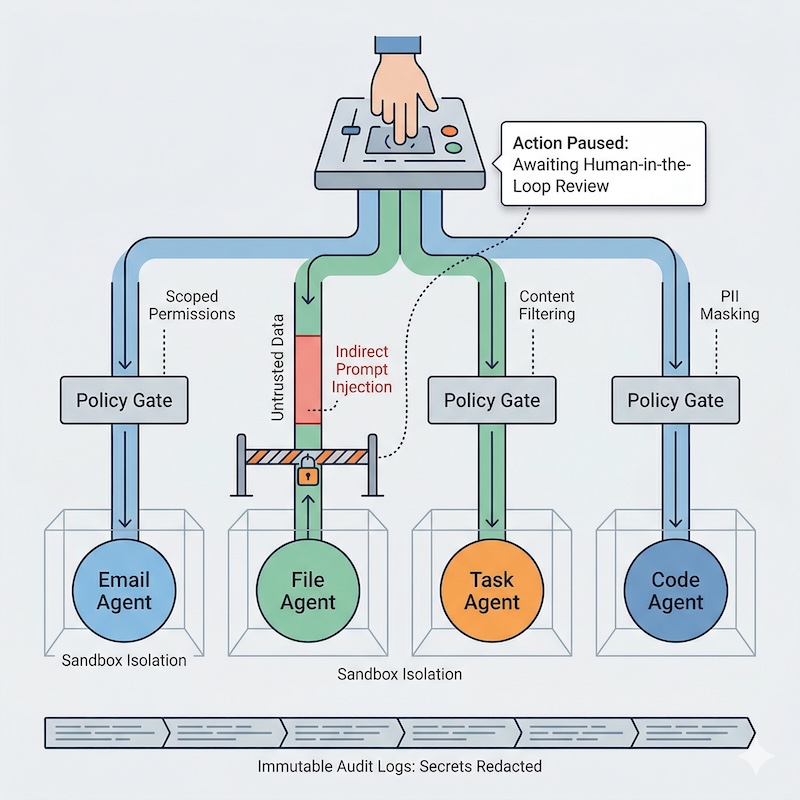
Indirect Prompt Injection (IPI) is an attack pattern in which untrusted content is treated as an instruction and then routed into privileged tool actions. The dangerous instruction is often buried in fetched data, not typed by the user: a malicious calendar invite, a hidden <div> on a page, or a poisoned document.
Data-to-Instruction Transduction is the underlying failure mode: the system treats untrusted data as if it were an instruction, then carries that mistake into tool execution.
Break the chain at multiple points, and the risk becomes much more manageable.
A practical safe baseline looks like this: treat all external content as untrusted, keep tool permissions narrow, require approval for irreversible actions, isolate runtime execution, prune sensitive context between tasks, and log every side effect without storing raw secrets or Personally Identifiable Information (PII).
No single control stops every agent failure mode, but layered controls dramatically reduce the odds that hidden instructions will turn into real actions.
The Three Deployment Patterns (and Their Privacy Trade-offs)
A cloud LLM + cloud tools setup is fast to launch and often easiest for product teams.
Trade-off: your prompts, context, and tool arguments may pass through external infrastructure, and governance shifts toward contracts and provider controls.
A local LLM + local tools setup gives stronger data locality and operational control.
Trade-off: you own patching, runtime hardening, model provenance checks, and operational reliability.
3. Hybrid (Most Common in Practice)
Sensitive paths stay local; lower-risk workloads use cloud APIs.
Trade-off: policy complexity increases, because your guardrails must remain consistent across multiple execution surfaces.
The Model Context Protocol (MCP) is an open protocol for connecting AI models to external tools and data sources. MCP can make this architecture cleaner, but it does not provide security on its own. The protection comes from where MCP servers run, what they can access, and whether every tool request is policy-checked before execution.
Trust Boundary in a Hybrid MCP Stack
                    Untrusted / External Zone
User -> Cloud LLM Planner -> Retrieval/Web Fetch
                 |
                 | Tool Request (policy-evaluated)
                 v
------------------------------------------------------------
                Trust Boundary (Your Perimeter)
MCP Server(s) -> Policy Engine -> Tool Runner -> Local Data
                                  |               (DB, files, APIs)
                                  v
                            Immutable Audit Log
------------------------------------------------------------
Cloud reasoning can still be useful, but privileged tool execution and sensitive data handling should remain inside your controlled boundary wherever possible.
Rule: Every tool call should be authorized as if it were an API request from an untrusted client.
Treat tools as privileged operations, not convenience functions.
🔒 Subscribe to keep reading.
A Small Command Allowlist Pattern
🔒 Subscribe to keep reading.
Common AI Agent Failure Modes: Context Bleed, Silent Retries, and Log Leaks
🔒 Subscribe to keep reading.
🔒 Subscribe to keep reading.
20-Minute Hardening Checklist
🔒 Subscribe to keep reading.
Adversarial Testing for Indirect Prompt Injection in AI Agents
🔒 Subscribe to keep reading.
Layered Defense: Why No Single Control Is Enough
🔒 Subscribe to keep reading.
References
🔒 Subscribe to keep reading.