How to Audit a Flask App With Reusable AI Security Skills
I do not enjoy security audits. I suspect most developers do not put them at the top of their Friday-afternoon wish list either. They are the kind of task everyone agrees is important and nobody wants to do this week, which is exactly why “we will get to it eventually” projects stay unaudited until something goes wrong. I have a small Flask app I built to track my own AI subscriptions — which tools I actually use, what they cost, whether they are earning their place — and I wanted it checked properly before I trusted it with my own data. Not a five-minute glance. A real review. That meant an actual security audit of the Flask app’s code — reading it the way an attacker would, not skimming for the obvious stuff — rather than a vague once-over.
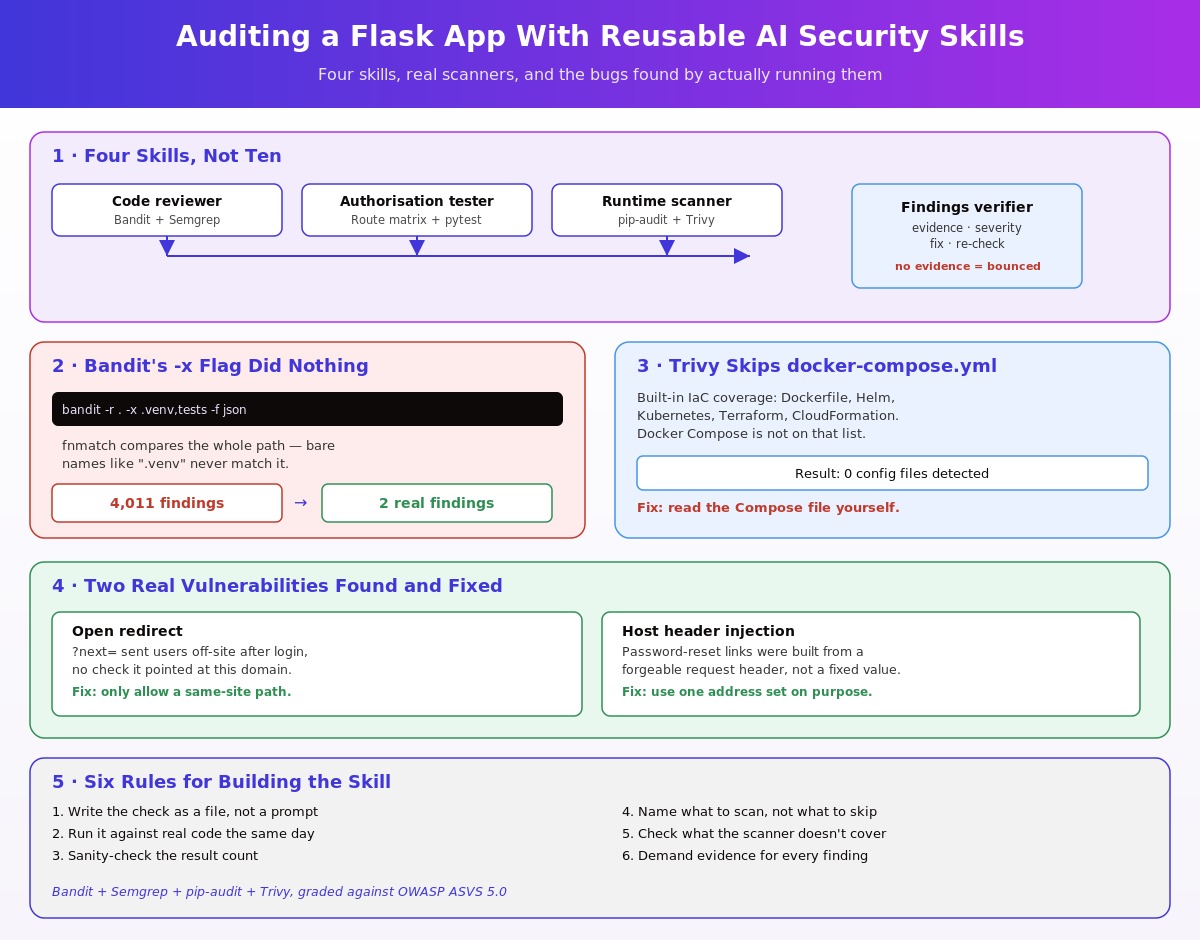
So instead of asking an AI agent to vaguely “check the security” of my app, I built something I can reuse. This post is about that process: how a ChatGPT brainstorm turned into four reusable Claude skills, what tools they run under the hood, and — this is the part I actually want you to remember — how testing them against a real app immediately caught mistakes in their own instructions, before those mistakes could waste anyone’s time later.
If you build small tools with AI assistance the way I do (I wrote about my general workflow for turning prompts into deployed apps a while back), this is the missing piece: a repeatable way to check what you shipped actually holds up.
Why a Reusable AI Security Skill Beats a One-Off “Check My Security” Prompt
An AI skill is a versioned instruction file — scope, permitted tools, required output format — that an AI agent loads and follows the same way on every run, rather than a prompt improvised per conversation. That difference is the whole point of this post.
“Please check this app for security issues” is not an instruction. It is a wish. An AI agent given that prompt alone will either invent plausible-sounding vulnerabilities that are not real, or miss the boring, well-documented ones that actual scanners catch in seconds. Neither outcome is useful, and both waste your time verifying claims that should have been solid in the first place.
I asked ChatGPT to sketch out what a proper version of this would look like, treating it the way a security consultancy would: narrow, repeatable checks, each with a defined scope, a list of permitted tools, and an expected output format. ChatGPT’s answer was a ten-skill breakdown — a code reviewer, an authorisation tester, a test generator, a dependency auditor, a headers auditor, a dynamic scanner, an authenticated-journey scanner, an abuse tester, a secrets reviewer, and a findings verifier — plus its own advice not to start with all ten at once. Fewer, more reusable skills beat ten independent agents nobody keeps maintained.
I fed that whole brainstorm to Claude, which had just finished building the subscription-tracking app, and asked it to turn the recommendation into something real: a skill set generic enough to run against this app today and any other Flask app I build later, saved in my own reusable skills repository rather than living only in one conversation.
The Four Flask Security Skills: Code Reviewer, Authorisation Tester, Runtime Scanner, Findings Verifier
🔒 Subscribe to keep reading.
Two Scanner Bugs Found by Testing the Skills: Bandit’s -x Exclude Flag and Trivy’s Docker Compose Gap
🔒 Subscribe to keep reading.
Flask Vulnerabilities Found: Open Redirect and Host-Header Password-Reset Poisoning
🔒 Subscribe to keep reading.
Checklist for Building and Testing an AI Security-Audit Skill
🔒 Subscribe to keep reading.
What an AI Security Audit Does and Does Not Prove
🔒 Subscribe to keep reading.
Should You Build Reusable AI Security Skills for Your Own Apps?
🔒 Subscribe to keep reading.
References
🔒 Subscribe to keep reading.
You've hit a Deep Dive tutorial.
I spend dozens of hours researching, coding, and breaking things to write these guides. This content is free, but reserved for my subscriber community. Drop your email below to unlock this guide (and all past/future deep dives):
Full content temporarily unavailable — refresh in a moment
Already a subscriber? Use the magic link from your last newsletter, or reset your password.
Log in to unlock
New subscribers get an inbox mail: Set a password to unlock articles. The form does not log you in — use the same email afterwards.