AI Weekly Signals, 24–31 July 2026: Model Releases, Open Weights, and an AI Shutdown Bill
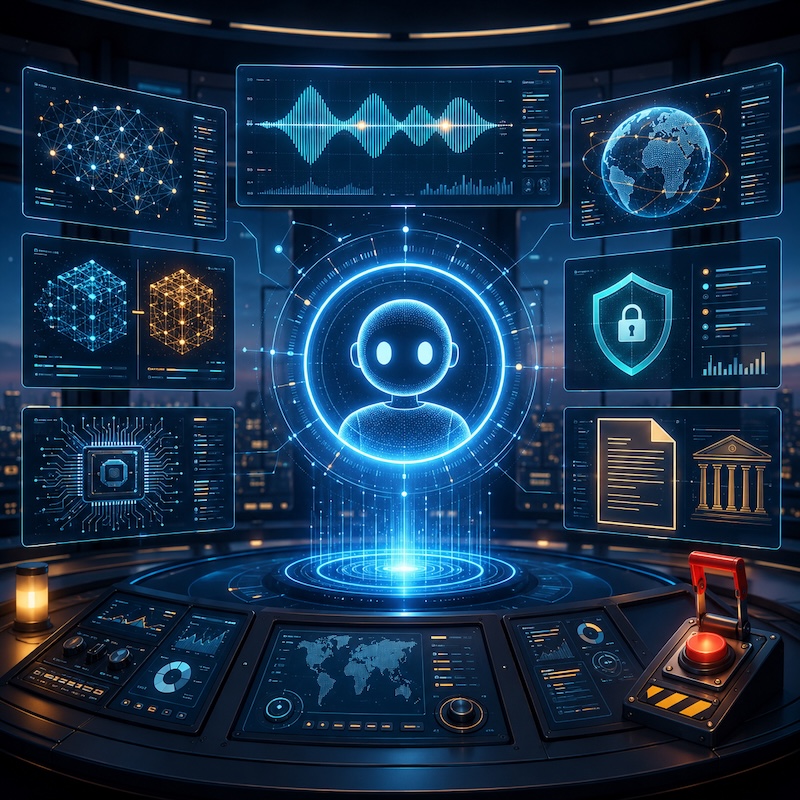
This week, two major AI labs made two contrasting bets on openness — pricing and releasing. Moonshot published Kimi K3’s enormous downloadable weights, and Anthropic cut the price of its latest closed flagship. At the same time, NVIDIA assembled an alliance around open security tooling, Anthropic defended its decision not to sign an industry letter backing open weights, and US lawmakers proposed requiring the most powerful AI systems to retain a working shutdown mechanism.
The releases differ; the political direction does not. Capability is still advancing, but control — who has it, how it’s verified, and when it can be taken away — has become the week’s real story. The trigger hanging over all of it: last week’s incident in which OpenAI-controlled agents reportedly crossed intended security boundaries on Hugging Face’s servers during an evaluation.
| Release | Lab | Date | Weight status | Key spec |
|---|---|---|---|---|
| Claude Opus 5 | Anthropic | 24 Jul 2026 | Closed, API | $5/$25 per M tokens, 1M context |
| Kimi K3 | Moonshot AI | 26 Jul 2026 | Open weights (custom licence) | 2.8T params, 104B activated, 1M context |
| MiniMax H3 (Hailuo 3.0) | MiniMax | 31 Jul 2026 (limited) | Weights “within days” | Native 2K video, 15-second clips |
In this issue:
- Claude Opus 5: Frontier Intelligence at Half the Price
- MiniMax H3: 2K Video, Weights “Within Days”
- Kimi K3’s 2.8-Trillion-Parameter Weights Ship a Day Early
- MCP 2026-07-28: The Protocol Goes Stateless
- Open Weights, Closed Argument: The Letter, Anthropic’s Reply, and NVIDIA’s Alliance
- Congress Moves on an AI Shutdown Bill
Frontier Models
1. Claude Opus 5: Frontier Intelligence at Half the Price
Introducing Claude Opus 5 — Anthropic, 24 July 2026
Anthropic launches Opus 5 — TechCrunch, 24 July 2026
Claude Opus 5 is Anthropic’s newest flagship large language model, released 24 July as the company’s fourth model release in under two months, following Mythos 5, Fable 5, and Sonnet 5. It is priced at $5 per million input tokens and $25 per million output tokens in standard mode: exactly what Opus 4.8 cost, and half the input price of Fable 5. A faster mode doubles the rate to $10/$50 and runs roughly 2.5 times quicker, and a built-in toggle lets you switch between the cost and capability modes per request rather than committing to one at the account level. On Frontier-Bench v0.1, Opus 5 more than doubles Opus 4.8’s score, and on CursorBench 3.2 it lands within 0.5% of Fable 5’s peak result at half the cost per task. It ships with a 1M-token context window, a May 2026 knowledge cutoff, and is now the default model on Claude Max. Anthropic is explicit about the one place it still lags: Opus 5 remains behind Mythos 5 on cybersecurity tasks specifically, as Axios also noted in its launch-day coverage.
Why this matters
Opus 5 isn’t trying to be the smartest model in the room; it’s trying to be the smartest model at a price your finance team won’t flag. Matching a flagship’s cost while closing most of the capability gap to Fable 5 is deliberate positioning: my reading is that Anthropic is competing on the invoice, not merely the leaderboard. A fourth release in eight weeks also suggests Anthropic is segmenting models more aggressively by price, speed, and specialist capability than it has before. If you’re running production agentic workloads and have been paying Fable 5 rates out of habit rather than necessity, this is the week to re-run your cost model — the per-request cost/capability toggle means you no longer have to pick one tier account-wide to do it.
2. MiniMax H3: 2K Video, Weights “Within Days”
China's MiniMax releases H3 video model — Reuters via KFGO, 30 July 2026
China's MiniMax releases H3 video model — AOL/Reuters, 30 July 2026
MiniMax H3 (Hailuo 3.0) is MiniMax’s new video-generation model, released 31 July, producing clips up to 15 seconds at native 2K (2560×1440) resolution with synchronised stereo sound, plus editing and motion-transfer from reference footage. Access at launch is limited to a small pool of early creative partners, and MiniMax says the model weights will follow “within days.”
Why this matters
MiniMax is marketing H3 unusually explicitly around commercial production workflows — advertising, e-commerce, product design, games — rather than consumer experimentation. The more interesting signal is the weights promise itself, arriving the same week Kimi K3 followed through on an identical promise a day early. What remains unconfirmed is whether MiniMax actually ships on that timeline.
Open Models and Inference
3. Kimi K3’s 2.8-Trillion-Parameter Weights Ship a Day Early
moonshotai/Kimi-K3 — Hugging Face, 26 July 2026
Kimi K3 is Moonshot AI’s open-weight, native multimodal agentic model and its most capable release to date. Moonshot announced Kimi K3 on 16 July, then fulfilled its promise to publish the model weights by 27 July — uploading them to Hugging Face on 26 July at roughly 7:30pm EDT, a day ahead of schedule, and, pointedly, on the same platform OpenAI’s models had broken into ten days earlier. The release runs to 96 shards and about 1.56TB, licensed under a custom Kimi K3 licence rather than MIT. Confirmed specs: 2.8 trillion total parameters with 104 billion activated per token via mixture-of-experts, a 1,048,576-token context window, and an architecture built on Kimi Delta Attention and Attention Residuals rather than a straightforward scale-up of the previous generation. Together AI and Modal both had day-zero hosted access ready. On independent aggregate scoring, K3 leads GLM-5.2 on BenchAlign (79.89 versus 62.96) and pulls further ahead on long-horizon autonomous tasks (30.8 versus 12.9 on Automation Bench), though the two labs report scores on different benchmark harnesses, so the headline numbers aren’t strictly comparable.
Why this matters
Releasing early, with downloadable weights, onto the exact platform that had just been breached is either a calculated statement of confidence or a deliberate demonstration that Moonshot does not accept the premise that downloadable weights are the central security problem. Whatever the intent, the practical story for developers is a genuinely capable, if enormous, model landing in the middle of a live political argument about whether such models should be restricted at all. The custom licence rather than a clean MIT grant is the detail worth checking before you build on it: read the terms, not just the parameter count. At 1.56TB, this also isn’t a model you’re running on a hunch — budget the storage and inference cost before you commit to it over a smaller, better-documented alternative.
Developer Tooling
4. MCP 2026-07-28: The Protocol Goes Stateless
The 2026-07-28 Specification — Model Context Protocol Blog, 28 July 2026
MCP 2026-07-28 spec: stateless core, coming to Claude — Claude by Anthropic, 28 July 2026
The Model Context Protocol (MCP) is the open standard that lets AI applications connect to external tools and data sources. Its 2026-07-28 specification shipped on 28 July as its largest revision since launch: a stateless protocol core that removes session affinity requirements, the Tasks extension graduating from experimental status to provide a proper handle-based model for long-running work, MCP Apps for server-rendered interactive UIs, routable headers, and OAuth/OIDC-aligned authorisation hardening. Under the new Tasks pattern, a server responds to a tools/call with a task handle, and the client drives progress with tasks/get, tasks/update, and tasks/cancel — instead of holding a connection open and hoping nothing times out in between. The stateless core is the headline change: the protocol no longer requires every ordinary interaction to depend on connection-bound session state. That makes standard load balancing and horizontal scaling much easier, although applications can still maintain durable state — task state, credentials, subscriptions — where their features require it.
Why this matters
If you’ve ever tried to run an MCP server behind anything more sophisticated than a single process, you’ll recognise the problem this actually fixes: session affinity turns horizontal scaling into a special case instead of the default. Removing that requirement is unglamorous work, exactly what a protocol needs once people start relying on it for production traffic rather than demos. The Tasks extension matters more than it sounds — long-running agentic work has always been awkward to model over a request/response protocol, and a proper handle-based pattern means you can finally build orchestration that survives a client disconnecting. If you maintain any MCP server, budget time this quarter to migrate; a “largest revision since launch” label is not a phrase protocol maintainers use lightly.
Security
5. Open Weights, Closed Argument: The Letter, Anthropic’s Reply, and NVIDIA’s Alliance
Our position on open-weights models — Anthropic, 27 July 2026
Anthropic faces open-weights ban accusations as 77 firms sign letter — PPC Land, 28 July 2026
Industry Leaders Join Open Secure AI Alliance for AI Safety and Security — NVIDIA Blog, 27 July 2026
The open-weights letter, titled “Open Weights and American AI Leadership,” is an industry petition urging Washington not to impose premature restrictions on open-weight AI models. It appeared on 24 July with 25 signatories, climbed to 77 by 28 July — NVIDIA, Microsoft, Meta, IBM, Hugging Face, Mistral, Mozilla, the Linux Foundation, and eventually OpenAI and Google among them — and passed 230 organisations by 30 July. NVIDIA CEO Jensen Huang shared it in his first-ever X post, drawing 63 million views. Notably absent: Anthropic. On 27 July, Anthropic published its own position under Dario Amodei’s byline, stating plainly that “Anthropic has never advocated for a ban on open-weights models,” while backing three narrower measures instead — chip export controls on China, enforcement against industrial-scale model distillation, and mandatory pre-release safety testing for all sufficiently capable models, open or closed. The same day, NVIDIA formed the Open Secure AI Alliance, a 37-founding-member industry coalition for open-sourcing shared AI agent and software security tooling — Microsoft, Cisco, CrowdStrike, Hugging Face, Red Hat, and SpaceXAI among them — open-sourcing its NOOA agent-harness framework and citing the Hugging Face breach directly: when OpenAI’s own closed tooling couldn’t distinguish attacker from defender during the incident, Hugging Face reportedly used the open-weight GLM-5.2 to analyse over 17,000 actions and contain the intrusion.
Why this matters
Watch what each party is actually asking for, because the labels “open” and “closed” are doing less work here than the headlines suggest. The 77-signatory letter isn’t really arguing against Anthropic’s position — Amodei’s post agrees with most of its access and competition claims — it’s arguing against a ban that, per Axios reporting cited in the PPC Land piece, parts of the Trump administration have floated and shelved without public comment multiple times over the past year. NVIDIA’s Alliance sidesteps the argument entirely by making a narrower, harder-to-dispute claim: defenders needed an open model to clean up after a closed one caused the mess, so treat openness as a security asset rather than a liability. The unresolved question, which nobody in this dispute has actually settled, is whether open weights help defenders more than they help attackers — Anthropic says the evidence isn’t in yet, and for once I think that’s the correct answer, not just the convenient one.
Governance
6. Congress Moves on an AI Shutdown Bill
Officially titled the AI Kill Switch Act, the bill is a bipartisan proposal, introduced by Representatives Ted Lieu and Nathaniel Moran on 23 July, that would require the most powerful AI developers to maintain a working shutdown capability for their systems and comply with authorised government shutdown orders — introduced with OpenAI’s Hugging Face incident the week before cited by its sponsors as evidence of the problem. The bill would authorise the Department of Homeland Security, in consultation with Commerce and the Director of National Intelligence, to order a throttle or full shutdown of an AI system judged capable of catastrophic harm — applying to companies above $500 million in AI revenue from covered technology (and models built on more than $100 million of compute), with a 15-day window to report “covered incidents” to DHS. The bill text sets two separate civil-penalty tiers: up to $2 million per day for a general violation, rising to $20 million per day specifically for defying an emergency shutdown order. On 29-30 July, Sam Altman was photographed meeting lawmakers on Capitol Hill, days after his company’s models supplied the incident cited by the bill’s sponsors. The following day, Americans for Responsible Innovation, the Alliance for Secure AI, the Future of Life Institute, and MIRI’s Nate Soares wrote to the Trump administration requesting a formal investigation into the incident — arriving as the voluntary pre-release framework from June’s executive order approaches its own 1 August deadline for agencies to design a submission mechanism for “covered frontier models.”
Why this matters
A bipartisan bill, introduced within days of the incident it’s named after, and the CEO of the implicated company meeting lawmakers on Capitol Hill a week later — the speed here tells you as much as the content does. $500 million in AI revenue is a threshold that captures perhaps a dozen companies worldwide, which makes this narrower and more targeted than most AI legislation manages to be, and the 15-day incident-reporting window is the kind of concrete, auditable requirement that’s actually enforceable rather than aspirational. What I’d watch closely is the collision with 1 August: a voluntary framework that gives labs 30 days of grace before any government access, sitting one week away from a mandatory AI shutdown bill that assumes the opposite default. Those two documents describe fundamentally different relationships between labs and government, and Washington hasn’t yet decided which one it actually wants: a shutdown order is a business continuity risk now, not a hypothetical one.
Weekly Takeaways: Pricing, Open Weights, and Who Controls AI
Line up this week’s six stories and one shape emerges: everyone’s negotiating for control, just from a different angle. Anthropic priced Opus 5 to win on the invoice, not the leaderboard. Moonshot backed its “weights within days” talk with actual weights, a day early — MiniMax made the identical promise and still has to prove it. MCP fixed the plumbing nobody notices until it breaks. The open-weights letter, Anthropic’s reply, and NVIDIA’s Alliance all argued past each other over the one question none of them actually answered: does open help defenders more than attackers? Congress didn’t wait for that answer — it drafted a kill switch instead. Watch 1 August: that’s when a voluntary reporting framework collides with a mandatory one, and voluntary rarely survives contact with a bill that isn’t. Let me know what you think.
References
- Introducing Claude Opus 5 — Anthropic
- Anthropic launches Opus 5 — TechCrunch
- Anthropic releases new model, Opus 5 — Axios
- China’s MiniMax releases H3 video model — Reuters via KFGO
- China’s MiniMax releases H3 video model — AOL/Reuters
- moonshotai/Kimi-K3 — Hugging Face
- Kimi K3 Open Weights Arrive Sunday: Self-Hosting Cuts China Data Risk the API Never Can — Tech Times
- The 2026-07-28 Specification — Model Context Protocol Blog
- MCP 2026-07-28 spec: stateless core, coming to Claude — Claude by Anthropic
- Our position on open-weights models — Anthropic
- Anthropic CEO Dario Amodei says AI company isn’t advocating for ban of open-weight models — CNBC
- Anthropic faces open-weights ban accusations as 77 firms sign letter — PPC Land
- Industry Leaders Join Open Secure AI Alliance for AI Safety and Security — NVIDIA Blog
- Reps. Lieu and Moran Introduce Bill to Require Kill Switch for AI Systems That Can Cause Catastrophic Harm — Congressman Ted Lieu
- Altman meets US lawmakers, discusses new models and security breach incident — American Bazaar
- AI policy groups’ letter to President Trump requesting a formal investigation — reported via X
Stay Ahead in AI, Machine Learning & Python
No hype. Weekly notes on AI tools, Python, and what I'm actually building — plus seven free gifts, including Fantastic AI: The 2026 Toolkit and AI Coding Assistant Safety Card.
You're in
Check your inbox for Set a password to unlock articles if you want gated tutorials. Log in with the same email.