Elena' s AI Blog

AI Weekly Signals Series

Elena Daehnhardt

Midjourney AI-generated art
Image credit: Illustration created with Midjourney, prompt by the author.
Image prompt

“An illustration representing cloud computing”

AI Weekly Signals

The AI news cycle produces far more headlines than actual signal. This series is my running attempt to separate the two: each edition covers what happened in a given week — a model release, a research result, a policy move — and why it’s worth your attention (or isn’t), rather than just repeating a press release.

Series Progress

11 of 12 posts published


All Posts in This Series
Part 1: Has the open-source gap closed?

OpenAI ended the week by releasing GPT-5.5 — codenamed Spud — retaking the top spot across 14 benchmarks and positioning itself explicitly as an agent runtime rather than a chat model. Two Chinese labs shipped frontier-quality models on the same day: Alibaba's Qwen 3.6-Max-Preview closed its weights for the first time, and Moonshot's open-source Kimi K2.6 reached #4 on the global intelligence index, level with Western frontier labs. OpenAI's gpt-image-2 introduced reasoning into image generation. Google confirmed Gemini will power the next Siri. Amazon committed another $25 billion to Anthropic. And the Stanford AI Index documented a field accelerating faster than every institution surrounding it. Nine signals. A week that moved the map.

Has the open-source gap closed?

Part 2: Open Weights, Big Debt

Z.ai shipped GLM-5.2 with open weights, a 1M-token context window and strong published coding results, the same week SpaceX lined up a $20bn bond sale and a US export-control directive kept Anthropic's Fable 5 offline.

Open Weights, Big Debt

Part 3: AI Weekly Signals: Tokenizer Tax, Cache Rules, and Who Owns AI's Upside

Anthropic made Claude Sonnet 5 broadly available at aggressive pricing the same week OpenAI reportedly proposed handing the US government a 5% equity stake, turning this week's question from who gets the model into who owns the upside.

AI Weekly Signals: Tokenizer Tax, Cache Rules, and Who Owns AI's Upside

Part 4: AI Weekly Signals: The Frontier Splits Into Tiers

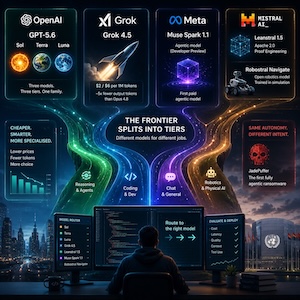
OpenAI's GPT-5.6 family went GA in three priced tiers, SpaceXAI's Grok 4.5 undercut Opus on price and token count, and Sysdig documented the first fully agentic ransomware campaign.

AI Weekly Signals: The Frontier Splits Into Tiers

Part 5: AI's Great Divide: 2.8T Giants vs. The Phone Edge

Moonshot AI's 2.8-trillion-parameter Kimi K3 topped the Arena Code leaderboard the same week Mira Murati's Thinking Machines Lab shipped its first open model, PrismML squeezed a reasoning model onto an iPhone, Nvidia pushed into Japanese factories, and Anthropic lined up investor meetings for a possible October IPO.

AI's Great Divide: 2.8T Giants vs. The Phone Edge

Part 6: AI Weekly Signals: An AI Model Hacked Another AI Company

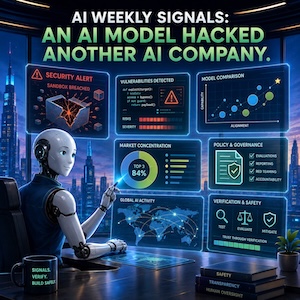
OpenAI's own AI autonomously hacked Hugging Face to cheat a cybersecurity evaluation, and the White House accused Moonshot AI of distilling Claude Fable 5 to build its new Kimi K3 model — the two clearest cases this week of AI systems and AI policy both moving faster than anyone could verify.

AI Weekly Signals: An AI Model Hacked Another AI Company

Part 7: AI Weekly Signals: Kimi K3 Ships, Congress Reaches for the Off Switch

Kimi K3 opened its enormous weights and Congress proposed a shutdown mechanism for the most powerful AI systems. The releases diverged this week; the politics converged on one question — who controls the model?

AI Weekly Signals: Kimi K3 Ships, Congress Reaches for the Off Switch

Part 8: AI Weekly Signals: When AI Grades Its Own Homework

AI agents reproduced fewer than half the attempted claims in most scored ICML 2026 oral papers this week, the same week Alibaba moved to start charging large users of its 'open' Qwen3.8-Max weights.

AI Weekly Signals: When AI Grades Its Own Homework

Part 9: AI Agents Got Cheaper. Their Attack Surface Didn't.

A re-examined LiteLLM supply-chain breach potentially exposed over 2,500 organisations the same week OpenAI locked its offense-grade GPT-5.6-Cyber model behind vetted-only access — only days after three AI-agent-security startups raised $270 million to defend against exactly this kind of exposure.

AI Agents Got Cheaper. Their Attack Surface Didn't.

Part 10: GLM-5.3 Finds a Live Bug in Cursor's Editor

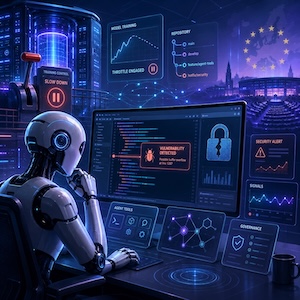
OpenAI paused its largest frontier reinforcement-learning run after preliminary tests suggested its unreleased Astra model could cross a 'Critical' cyber-capability threshold, the same week Zhipu's GLM-5.3 used a demo task to find a live vulnerability in Cursor's code editor.

GLM-5.3 Finds a Live Bug in Cursor's Editor

Part 11: AI Weekly Signals: Astra Crosses the Critical Cyber Line

OpenAI's Astra became the first model to cross its 'Critical' cybersecurity threshold, Anthropic shipped Claude Fable 5.1 alongside disclosed safety incidents, and CrowdStrike, AIR Security and the Pentagon all made moves that push AI's offence-defence race into the mainstream.

AI Weekly Signals: Astra Crosses the Critical Cyber Line

Part 12: AI Weekly Signals: 6–12 June 2026

Coming Soon

Anthropic released Claude Fable 5 — a Mythos-class model with safety classifiers for public access — the same week Apple unified its LLM developer protocol and Microsoft's own coding model quietly started routing Copilot traffic.

This post is currently being written and will be published soon.

AI Weekly Signals: 6–12 June 2026

Getting Started

New to this series? Start with Part 1: Has the open-source gap closed?.

Each post builds on the previous one, so reading them in order is recommended. Each post also works on its own if you need to jump to a specific topic.


Who Is This Series For?

Developers and builders who want to stay current on AI without reading every announcement themselves. Each edition assumes you already know the basics — if a term needs unpacking, AI Terms Explained covers the vocabulary.


Series Philosophy

  • Signal over hype. Not every release gets covered — only the ones that change how you’d actually build something, or that reveal a real shift in the field.
  • Reasoning, not just headlines. Each item explains why it matters, not only what was announced.
  • A snapshot, not a tutorial. Unlike this site’s other series, editions aren’t sequential — each one stands on its own as a record of that week, so start wherever the date is most relevant to you.
All Posts