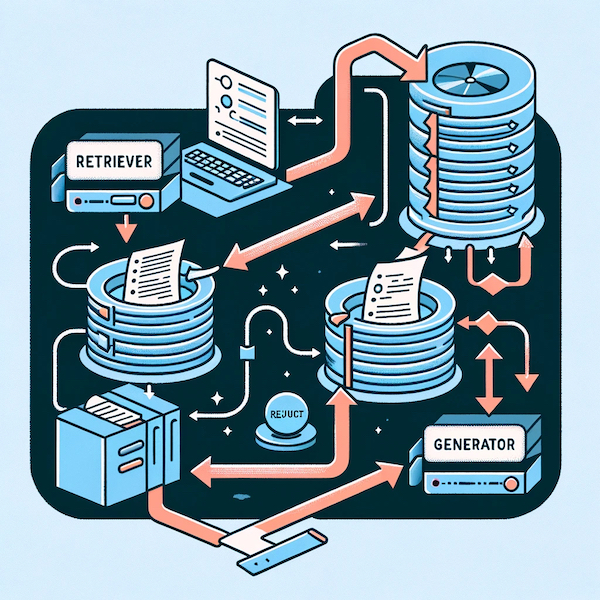
What is Retrieval-Augmented Generation (RAG)?
Retrieval-Augmented Generation (RAG) is an AI architecture that retrieves relevant documents from an external data source and feeds them to a large language model, so the model bases its answer on verified context instead of its parametric memory alone.
Large Language Models (LLMs) are incredibly impressive, but they have a fundamental flaw: they don’t actually know facts. They simply predict the next most likely word based on patterns in their training data. When they don’t know the answer, they make one up. This behaviour is what we call an AI hallucination.
In 2020, researchers at Facebook AI (now Meta AI) proposed a powerful solution to this problem: Retrieval-Augmented Generation (RAG). (Update, September 2026: that research group has since been folded into Meta Superintelligence Labs, formed in mid-2025 as part of a wider reorganisation of Meta’s AI research efforts.) You can read their foundational paper, Retrieval-Augmented Generation for Knowledge-Intensive NLP Tasks. The idea was simple but revolutionary: instead of relying on the model’s parametric memory (what it memorized during training), what if we forced it to retrieve relevant documents first, and then base its answer strictly on those documents?
RAG has since become the industry standard for building reliable AI applications. By grounding responses in real, up-to-date data, it makes AI vastly more factual and specific.
However, the possibility of hallucination in RAG systems should not be underestimated. Recent studies, such as Hallucination-Free? Assessing the Reliability of Leading AI Legal Research Tools, have shown that even sophisticated RAG pipelines in legal tools can sometimes provide misleading information if the retrieval step fails or the prompt is misinterpreted.
If you are interested in why AI hallucinates and what we can do about it, read my earlier post Can AI Hallucinate?
RAG in Two Steps: Retrieval and Generation
At its core, RAG is exactly what it sounds like. It is a two-step process:
- Retrieval: The system searches an external database (like a company wiki, a collection of PDFs, or the internet) to find information relevant to the user’s prompt.
- Generation: The system takes that retrieved information and feeds it to the LLM alongside the original prompt, instructing the model to generate an answer based only on the provided context.
How RAG Works
RAG employs a two-step process involving a retriever and a generator. The retriever identifies relevant documents or data based on the input query, and the generator uses this retrieved information to produce a coherent and accurate response.
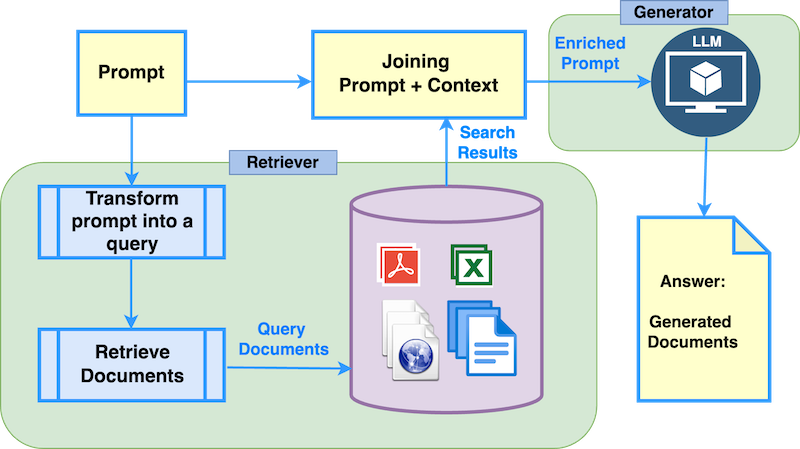
The main steps in the RAG Process include the following:
- Prompt Input: The user inputs a prompt.
- Retrieval: The user prompt is transformed into a query format that allows the retriever to search a large corpus for relevant documents. We can use text files, PDF documents, and any file formats or records used for a particular RAG implementation. The documents can include any information, such as product or service descriptions.
- Augmentation: Augmentation occurs when we combine the user prompt and context information. The retrieved documents are combined with the input query.
- Generation: The generative model produces a response using the augmented input.
Generative AI vs RAG: Key Differences
The main difference between standard Generative AI and RAG comes down to the information source. Standard LLMs rely solely on patterns frozen in time during their training phase; RAG fetches live data at query time. The table below summarises the trade-offs:
| Dimension | Standard Generative AI (LLM only) | Retrieval-Augmented Generation (RAG) |
|---|---|---|
| Information source | Parametric memory frozen at training time | External corpus retrieved at query time |
| Freshness | Knows nothing after its training cutoff | Reflects up-to-date documents on every query |
| Factual grounding | Prone to hallucinating unsupported facts | Answers anchored to retrieved context |
| Architecture complexity | Single model call | Retriever plus generator, more to build and maintain |
RAG Use Cases: Where RAG Shines
RAG is practically mandatory in scenarios where generating accurate, contextually relevant, and up-to-date information is crucial. We see it used heavily in:
- Question Answering Systems: Think of a customer support chatbot that pulls the latest return policies or troubleshooting manuals before answering a client.
- Content Generation with Context: Automated reporting tools that fetch the latest quarterly earnings data and generate a narrative summary.
- Personalized Recommendations: E-commerce systems that retrieve your past purchasing history and generate highly tailored product descriptions.
- Legal and Academic Work: Systems that fetch relevant case law or references and expand upon them with detailed arguments.
In all of these use cases, RAG anchors the generative AI to reality, making it immensely valuable in dynamic environments.
RAG Benefits and Challenges
The Promises of RAG
While RAG is a massive step forward, its benefits still depend heavily on implementation details. As we saw earlier, even sophisticated Legal AI tools can still hallucinate between 17% and 33% of the time despite using RAG architectures.
That being said, a well-built RAG system addresses the core shortcomings of generative AI by:
- Improved Accuracy and Relevance: By grounding the generative process in real-world data, RAG enhances the accuracy and relevance of the outputs.
- Enhanced Contextual Understanding: RAG leverages retrieved documents to provide contextually rich and coherent responses. We can feed RAG systems with essential documents to add context to the generative component.
- Reduced Hallucinations: By relying on factual data, RAG significantly reduces the instances of AI hallucinations. For instance, CustomGPT.AI offers a powerful approach to reducing AI hallucinations by leveraging domain-specific knowledge, high-quality data, and user feedback (read more in How To Stop ChatGPT From Making Things Up – The Hallucinations Problem).
Challenges and Considerations
Data quality, retrieval accuracy, and integration are all vital for the success of RAG systems, and each poses specific challenges that require careful management and optimisation.
Data Quality: The quality of the data used for retrieval is crucial in RAG systems. The generated content will reflect these flaws if the data sources are outdated, biased, or inaccurate.
For example, a healthcare RAG system generating treatment recommendations might pull data from an outdated medical database, leading to potentially harmful advice. Ensuring high-quality, reliable data sources is essential for effective RAG performance.
Retrieval Accuracy: Retrieval accuracy refers to the system’s ability to find the most relevant and precise information for a given query. The generative model may produce incorrect or irrelevant content if the retrieval component fails to select the correct or most relevant documents.
For instance, in a legal RAG system, inaccurate retrieval might pull in unrelated case law, leading to incorrect legal arguments or advice. Fine-tuning retrieval algorithms to prioritise relevance and precision is critical.
Integration Challenges: Integrating retrieval and generation components seamlessly is a significant challenge in RAG systems. The retrieval process must be fast and efficient, while the generative model needs to effectively use the retrieved information to produce coherent and contextually appropriate content.
For example, in a customer service chatbot, the system must quickly retrieve relevant product information and generate a response that feels natural and helpful to the user. Ensuring smooth integration involves addressing technical issues like latency, data formatting, and the alignment of retrieved content with the generative model’s capabilities.
Future Directions
RAG Best Practices
Implementing the Retrieval and Generation (RAG) model effectively is essential for maximizing the quality and relevance of retrieved information and generated content. To achieve this, there are five key best practices to keep in mind:
-
Use High-Quality Data Sources: Ensure that you utilize reliable, up-to-date, and diverse data sources to enhance the accuracy and relevance of retrieved information. Regularly audit and update data repositories to maintain quality.
-
Optimize Retrieval Algorithms: Focus on improving retrieval accuracy by fine-tuning algorithms to prioritize relevance and context. Employ advanced search techniques, such as semantic search, to better match queries with appropriate content.
-
Streamline Integration: Ensure a seamless interaction between the retrieval and generation components. Optimize data pipelines for speed and efficiency and use techniques like fine-tuning and prompt engineering to align the retrieved content with the generative model’s capabilities.
-
Implement Feedback Loops: Continuously gather and incorporate user feedback into the system to improve retrieval accuracy and generation quality over time. This helps refine the model and address any performance gaps.
-
Monitor and Mitigate Bias: Regularly check for and mitigate any biases in retrieved data and generated content. Use diverse data sources and employ fairness techniques to ensure the system produces balanced and fair outputs.
These best practices will help you effectively implement the RAG model and maximize the quality and relevance of the retrieved information and generated content.
Emerging Trends in RAG
The emerging Trends and application examples in RAG include:
- Integration with Large Language Models (LLMs):
- Trend: As large language models (LLMs) like GPT-4 evolve, integrating them with advanced retrieval systems is becoming more common. (GPT-4 was the frontier model when this was written in 2024; newer flagship models have since taken that role, but the retrieval-plus-LLM integration pattern described here still holds.) This trend allows for generating more accurate and contextually rich content by leveraging the vast knowledge base of LLMs alongside real-time information retrieval.
- Example: Enhanced chatbots and virtual assistants that can pull in specific, up-to-date information from databases or the web while maintaining the conversational fluency of an LLM.
- Real-Time Data Retrieval:
- Trend: The move toward real-time or near-real-time data retrieval in RAG systems is gaining momentum. This allows for generating content that reflects the most current information available, making RAG systems highly valuable in dynamic fields like finance, news, and healthcare.
- Example: News summarisation tools that can retrieve the latest updates on an ongoing event and generate concise summaries in real-time.
- Personalisation and Contextualisation:
- Trend: There is a growing focus on using RAG systems to provide highly personalised and contextually aware content. By leveraging user-specific data during retrieval, these systems can generate content tailored to individual needs and preferences.
- Example: Personalised learning platforms that retrieve relevant educational materials and generate study guides based on a student’s unique learning history and current progress.
- Cross-Domain Applications:
- Trend: RAG is being applied across multiple domains, combining information from diverse fields to generate interdisciplinary insights. This trend is particularly useful in complex scenarios like healthcare, where combining medical, lifestyle, and environmental data can lead to more comprehensive recommendations.
- Example: A healthcare application that retrieves data from medical records, lifestyle surveys, and environmental factors to generate personalised health plans.
- Explainability and Transparency:
- Trend: As RAG systems become more sophisticated, there is a rising demand for explainability and transparency in retrieving and generating content. This includes developing systems explaining their information sources and the reasoning behind their outputs.
- Example: A legal RAG system that not only generates legal documents but also provides a transparent explanation of the sources used and how legal precedents were applied in the reasoning process.
In my post Explainable AI is possible, I argue that black-box-approach is oversimplification of how AI systems work and that it is indeed possible creating transparent and explainable AI programs.
- Enhanced Multimodal Capabilities:
- Trend: Emerging RAG systems are increasingly capable of handling and integrating multiple data modalities (e.g., text, images, audio). This allows for richer, more nuanced content generation from diverse data types.
- Example: A creative tool retrieving textual and visual content to generate comprehensive multimedia presentations or design concepts.
- Scalability and Efficiency Improvements:
- Trend: Efforts are being made to improve RAG systems’ scalability and efficiency, particularly in managing large-scale data retrieval and reducing latency in real-time applications. This involves optimising infrastructure and algorithms for larger datasets and faster retrieval times.
- Example: Enterprise-level RAG systems that can quickly retrieve and process vast amounts of data across global operations, enabling more efficient decision-making and content generation.
These trends indicate a rapid evolution of RAG systems, emphasising real-time capabilities, personalisation, cross-domain functionality, and transparency. These trends are shaping the future of intelligent content generation.
Research Opportunities
RAG (Retrieval-Augmented Generation) is a rapidly evolving field, with numerous opportunities for research to enhance its capabilities, address current limitations, and explore new applications. Below are key research opportunities and references to relevant papers that can be accessed through Google Scholar.
- Improving Retrieval Accuracy:
- Opportunity: Research can focus on developing more sophisticated retrieval algorithms that better understand context, semantics, and user intent. This includes exploring advanced neural retrieval models and integrating them with traditional search techniques to improve precision and recall.
- You can read the most recent paper that focuses on “Evaluating Retrieval Quality in Retrieval-Augmented Generation” by Alireza Salemi and Hamed Zamani (2024). The authors propose a novel evaluation approach, eRAG, where each document in the retrieval list is individually utilised by the large language model within the RAG system. The output generated for each document is then evaluated based on the downstream task ground truth labels. In this manner, the downstream performance for each document serves as its relevance label.
- Scalability and Efficiency:
- Opportunity: As RAG systems are applied to larger datasets and real-time applications, research is needed to scale these systems efficiently. This includes exploring distributed computing, indexing techniques, and low-latency retrieval mechanisms.
- “Dense Passage Retrieval for Open-Domain Question Answering” by Karpukhin et al. (2020). Open-domain question answering can be improved using dense representations for passage retrieval. This method outperforms traditional sparse vector space models by 9%-19% in top-20 passage retrieval accuracy and helps achieve new state-of-the-art results in open-domain QA benchmarks. This paper presents methods for efficient retrieval, which is crucial for scaling RAG systems.
- Multimodal Retrieval and Generation:
- Opportunity: There is significant potential in exploring how RAG systems can handle and integrate multiple data modalities, such as text, images, and audio, to generate richer, more comprehensive content.
- “Unifying vision-and-language tasks via text generation” by Cho et al. (2021). This work proposes a unified framework for vision-and-language learning, which learns different tasks in a single architecture with the same language modeling objective. The approach performs comparable to recent task-specific state-of-the-art vision-and-language models on popular benchmarks and shows better generalisation ability on rare-answered questions. The framework also allows multi-task learning in a single architecture with a single set of parameters, achieving similar performance to separately optimised single-task models. The code is publicly available at https://github.com/j-min/VL-T5. This research opens the door to exploring multimodal RAG systems.
- Personalisation and Adaptive Systems:
- Opportunity: Developing personalised RAG systems that adapt to individual user preferences and contexts is a promising area. Research can explore adaptive retrieval methods and context-aware generation techniques.
- “Design and Implementation of an Interactive Question-Answering System with Retrieval-Augmented Generation for Personalized Databases” by Byun et al. (2024). The paper discusses designing and implementing an interactive question-answering system with retrieval-augmented generation for personalised databases. It discusses integrating large language models with personalised data to enhance search precision and relevance. The study used GPT-3.5 and text-embedding-ada-002 models and evaluated the approach’s effectiveness. The results indicate that the combination of GPT-3.5 and text-embedding-ada-002 is effective for a personalised database question-answering system, with the potential for various language models depending on the application.
- Bias Mitigation and Fairness:
- Opportunity: Ensuring fairness and mitigating biases in RAG systems is a critical research area. This involves developing methods to detect, quantify, and reduce biases in retrieval and generation components.
- “FairRAG: Fair Human Generation via Fair Retrieval Augmentation” by Shrestha et al. (2024). Existing text-to-image generative models often reflect societal biases ingrained in their training data, leading to bias against certain demographic groups. In response, we introduce Fair Retrieval Augmented Generation (FairRAG), a framework that conditions pre-trained generative models on reference images from an external database to improve fairness in human image generation. FairRAG enhances fairness by providing images from diverse demographic groups during the generative process, outperforming existing methods regarding demographic diversity, image-text alignment, and image fidelity.
- Explainability and Transparency:
- Opportunity: As RAG systems become more integrated into decision-making processes, research on making these systems more explainable and transparent is essential. This includes developing techniques for tracing retrieved information sources and explaining how it is used in generation.
- “RAG-based Explainable Prediction of Road Users Behaviors for Automated Driving using Knowledge Graphs and Large Language Models” by Hussien et al. (2024). Predicting road users’ behaviours in the context of autonomous driving has been a focus of recent scientific attention. The authors propose integrating Knowledge Graphs and Large Language Models to accurately predict road users’ behaviours. This system has shown promising results in predicting pedestrians’ crossing actions and lane change manoeuvres.
- Cross-Domain Knowledge Integration:
- Opportunity: There is potential in researching how RAG systems can effectively integrate and utilise cross-domain knowledge to generate content that draws on multiple fields, leading to more interdisciplinary insights.
- “Leveraging Multi-AI Agents for Cross-Domain Knowledge Discovery” by Aryal et al. (2024). The authors are developing a new approach to knowledge discovery using multiple specialised AI agents. These agents collaborate to provide comprehensive insights that go beyond single-domain expertise. We have conducted experiments demonstrating the effectiveness of this approach in identifying and bridging knowledge gaps. The main goal is to enhance knowledge discovery and decision-making by leveraging each agent’s unique strengths and perspectives. The authors plan to custom-train the agents with more data to improve performance.
These research opportunities offer a pathway to advancing the field of RAG, addressing current challenges, and unlocking new applications. Each referenced paper provides a foundation for exploring these areas further, and they can be accessed through Google Scholar for more in-depth study.
Conclusion: RAG Grounds Generative AI in Verified Data
Retrieval-Augmented Generation (RAG) is the architecture that grounds generative models in retrieved, verified data, and it has reshaped how we build practical AI applications. By combining the conversational fluency of generative models with the hard facts of a search engine, RAG allows us to build systems that are significantly more accurate, customisable to specific company data, and capable of scaling across massive document repositories.
The technology is still evolving rapidly. We are already seeing moves toward multimodal RAG (searching across images and video, not just text) and real-time data streaming. While challenges around data quality and residual hallucinations remain, RAG is undeniably the foundation for the next generation of enterprise AI.
Update (September 2026): Since I first wrote this post, million-token context windows from models such as Gemini and Claude sparked a genuine debate about whether long-context LLMs make retrieval unnecessary. The research answer is: not really. NVIDIA’s “Retrieval meets Long Context Large Language Models” found that combining retrieval with a long-context model still outperforms either technique alone, and the industry has largely converged on agentic RAG, where an LLM agent decides when, and what, to retrieve, rather than retrieval disappearing in favour of stuffing everything into the context window.
In my next post, I will dive into the code and write about practical RAG implementations.
Subscribe so you do not miss the new posts!
Try the following fantastic AI-powered applications.
I am affiliated with some of them (to support my blogging at no cost to you). I have also tried these apps myself, and I liked them.
Chatbase provides AI chatbots integration into websites.
CustomGPT.AI is a very accurate Retrieval-Augmented Generation tool that provides accurate answers using the latest ChatGPT to tackle the AI hallucination problem.
Flot.AI assists in writing, improving, paraphrasing, summarizing, explaining, and translating your text.
MindStudio.AI builds custom AI applications and automations without coding. Use the latest models from OpenAI, Anthropic, Google, Mistral, Meta, and more.
Originality.AI is very effecient plagiarism and AI content detection tool.
Did you like this post? Please let me know if you have any comments or suggestions.
Posts about AI that might be interesting for youRelated tools you may want to try next.
Fotor AI uses text-to-video generator technology that allows you to easily create, manage, and streamline cinematic AI avatar videos.
Hey Gen uses text-to-video generator technology that allows you to easily create, manage, and streamline cinematic AI avatar videos.
Hour One AI uses text-to-video generator technology that allows you to easily create, manage, and streamline cinematic AI avatar videos.
ImagineArt A great AI tool that can generate images from text prompts, and much more.
StoriesForKids Creates children books from text prompts.
Synthesia.io can generate videos from text prompts, creates AI avatars and much more.
References
2. Retrieval-Augmented Generation for Knowledge-Intensive NLP Tasks
3. Hallucination-Free? Assessing the Reliability of Leading AI Legal Research Tools
5. How To Stop ChatGPT From Making Things Up – The Hallucinations Problem
7. Retrieval-Augmented Generation for Knowledge-Intensive NLP Tasks
9. Evaluating Retrieval Quality in Retrieval-Augmented Generation
10. Dense Passage Retrieval for Open-Domain Question Answering
11. Unifying vision-and-language tasks via text generation
13. FairRAG: Fair Human Generation via Fair Retrieval Augmentation
15. Leveraging Multi-AI Agents for Cross-Domain Knowledge Discovery
17. Mark Zuckerberg announces creation of Meta Superintelligence Labs
Stay Ahead in AI, Machine Learning & Python
No hype. Weekly notes on AI tools, Python, and what I'm actually building — plus seven free gifts, including Fantastic AI: The 2026 Toolkit and AI Coding Assistant Safety Card.
You're in
Check your inbox for Set a password to unlock articles if you want gated tutorials. Log in with the same email.