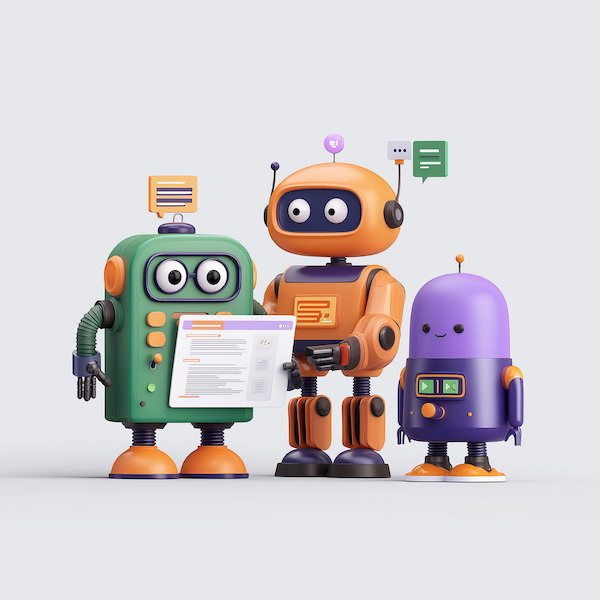
Comparing AI Coding Assistants: Gemini, ChatGPT, and Claude for Software Development
I do not believe in magic bullets. AI tools are immensely powerful coding assistants, but if you don’t understand software architecture, an LLM will simply help you write bad code much faster.
However, when used strategically, these tools fundamentally alter the development workflow. After months of intensive daily use, I have found that different models excel at vastly different aspects of software engineering.
In this post, we will look at a technical comparison of Google Gemini, ChatGPT, and Claude AI. We will evaluate their code generation capabilities, architectural awareness, and how the Model Context Protocol (MCP) is turning these chatbots into deeply integrated development agents.
Google Gemini
Google Gemini has a very generous free plan, and I love it for creating my JavaScript functions. The quality of the output is simply fantastic!
I think that Gemini is an excellent tool for quickly drafting Ajax functions, and this chatbot helped me learn JavaScript in no time. Let me tell you why I chose Gemini as my go-to for frontend development.
When I was working on a recent project that required complex Ajax interactions, I simply described what I needed:
Create an Ajax function that fetches user data from a REST API, handles loading states, and updates the DOM with error handling.
Gemini’s Flash 2.5 output was well-written, with good comments. I have also noticed that Gemini likes the Tailwind CSS Framework. However, you can request it using your preferred framework or remove the class references. It recently helped me to create my own tiny CSS framework for my prototypes. It was lightweight and had only the classes I needed.
Gemini’s API capabilities (as detailed in the official Gemini API documentation) make it particularly strong for web development tasks, and it generated clean, working code that I only needed to tweak slightly.
What impressed me most about Gemini is its understanding of modern JavaScript patterns. It consistently suggests ES6+ syntax, proper async/await usage, and even includes error boundaries. The integration possibilities are extensive, and you can experiment with different Generative AI models using Google AI Studio.
Next, I have asked Gemini Flask 2.5:
Create a fetch function that handles rate limiting and retries with exponential backoff.
It generated:
This is production-ready code with minimal modifications needed!
Gemini’s Debugging Superpower:
Gemini loves debugging indeed. Copy and paste the code, and it will identify issues you may have missed. I had a tricky closure problem in JavaScript that took me hours to spot; Gemini identified it in seconds and explained why the scope was incorrect. This debugging capability has saved me countless hours.
ChatGPT
ChatGPT is also great at drafting Python code; however, in my opinion, it often lacks thoroughness. It provides suggestions on how to accomplish tasks rather than completing the provided task. ChatGPT tends to give you conceptual guidance rather than complete implementations. It is pretty good for learning.
For instance, I was working on drafting a quick CSS Framework (I did not want to be dependent on Tailwind or Bulma, which are both great, by the way). I just wanted to implement several classes to make my little web app with the smallest CSS possible :) ChatGPT was lazy; Gemini did a great job.
When I asked ChatGPT (o4-mini-high) to polish my CSS file, it missed many class and name definitions!
But Gemini? It worked well in going through all my classes, creating a well-structured CSS file just as I wanted it:
The goal here is a truly clean, maintainable stylesheet. I'll maintain all the logic, variables, and responsiveness we've built, while focusing on:

Logical Grouping: Re-ordering and consolidating related CSS rules.

Comments: Clear and concise comments for each section and important rules.

Tabs Improvement: Enhancing the visual design of the tabs for both light and dark modes, and ensuring smooth transitions.

Consistency: Double-checking variable usage for borders, shadows, and colours across components.

Readability: Overall formatting for easier scanning and understanding.

Here's your re-organised and improved CSS file:
Funnily enough, it messed up the navbar-burger class, but that was easily fixed.
ChatGPT’s Limitations in Practice:
ChatGPT struggles with navigating large codebases and understanding the big picture of complex projects. I noticed this when asking it to refactor a multi-file Python project - it would focus on individual functions without considering the broader architecture.
In my own testing, ChatGPT’s code quality dropped noticeably on complex, multi-file refactors compared to single-function tasks. This is why I constantly review ChatGPT’s suggestions carefully, especially for production code.
Where ChatGPT Shines:
Despite these limitations, ChatGPT excels at:
- Explaining complex programming concepts
- Code documentation and commenting
- Algorithm explanations with step-by-step breakdowns
- Quick syntax reference for unfamiliar languages
Claude AI
Claude AI (specifically the Sonnet models) approaches code generation fundamentally differently than its peers. While Gemini optimizes for speed and ChatGPT leans towards high-level conceptual guidance, Claude’s training heavily weights defensive programming and SOLID architectural principles.
Claude’s Architectural Code Generation:
When I asked Claude Sonnet 4 to create a Python class for handling API requests, it didn’t just dump a basic requests.get() script. It provided a robust, enterprise-grade class structure:
Notice the type hints, custom exception classes, proper logging injection, and separation of concerns. Claude AI represents a defensive, architecture-first code generation model that defaults to production-ready patterns without additional prompting. It proactively implements features you would normally catch during a senior code review.
In contrast, ChatGPT 4o often takes a “lazy evaluation” approach. It will output the absolute bare minimum code required to solve the immediate prompt, and then casually ask: “Let me know if you’d like features like retry logic, logging, or async support.” You have to explicitly prompt ChatGPT to write production-ready code, whereas Claude defaults to it.
Model Context Protocol (MCP): Architecture for AI-Native IDE Integration
While generating code in a web browser is helpful, the future of AI development lies in direct IDE integration. This is being driven by the Model Context Protocol (MCP).
The Model Context Protocol (MCP) is an open standard introduced by Anthropic that fundamentally changes how AI interacts with local environments. As defined in the official MCP specification, it moves AI from being a passive chat window to an active agent embedded in your workspace.
Update: I am describing the 2025-06-18 revision of the spec here, which was current when I first wrote this piece. MCP has moved fast since then — the 2025-11-25 and 2026-07-28 revisions reworked a lot of the wire-level detail, dropping the old session handshake in favour of stateless requests and deprecating the Roots, Sampling, and Logging features. The Host/Client/Server picture below is still the right mental model; just know that the protocol underneath it has kept evolving.
How MCP Works Technically:
MCP operates on a strict Client-Server architecture:
- MCP Hosts: Applications like Claude Desktop or Cursor IDE act as the host.
- MCP Clients: Protocol clients operating inside the host application.
- MCP Servers: Lightweight local servers that expose specific capabilities (like reading the local filesystem, querying a SQLite database, or hitting a GitHub API).
Instead of manually copying and pasting log files into ChatGPT, an MCP-enabled assistant can query your local database directly, read your live project files, and write fixes back to disk.
Imagine typing: “Check the local SQLite database for test accounts created today, cross-reference them with the error logs in /var/logs, and write a patch to fix the authentication bug.” With MCP, the LLM requests tool execution from the local MCP servers, reads the data, and writes the code automatically.
The protocol has gained massive traction. Anthropic open-sourced MCP, and now OpenAI has added MCP support to their Agents SDK.
Security Considerations:
I like learning new things, so I want to know MCP better; however, let’s also ponder the maturity of the MCP protocol, particularly its security aspects.
MCP enables seamless integration between LLM applications and external data sources, but this creates new security considerations. The protocol’s own security best practices documentation spells out concrete attack classes here, including the confused deputy problem, token passthrough, and server-side request forgery against MCP clients. As outlined in the DataCamp MCP tutorial, security concerns include ensuring proper authorisation and authentication mechanisms are in place to prevent unauthorised access to external resources. MCP creates new attack vectors through indirect prompt injection vulnerabilities, where attackers could craft malicious messages containing hidden instructions.
Security experts recommend treating any MCP integration with caution and implementing proper access controls. For practical implementation guidance, the MCP implementation guide provides detailed examples of building secure MCP servers. Never give AI tools unrestricted access to critical systems.
My MCP Security Rules:
- Always review: Never let MCP tools execute commands without human approval
- Least privilege: Give MCP servers minimal necessary permissions
- Audit everything: Log all MCP interactions for security review
- Test in isolation: Experiment with MCP in sandboxed environments first
Best Practices for Using AI Coding Assistants Safely and Effectively
Sure, you still need to use your brain, but generative AI turns coding into a genuine learning experience — and it can save you real time on coding and debugging.
Here is my approach to using these tools effectively:
The Learning Approach:
- Use AI to understand new concepts, not just copy code
- Ask “why” questions: “Why did you choose this approach?”
- Experiment with AI suggestions in isolated environments
- Always read and understand generated code before using it
The Productivity Approach:
- Use AI for boilerplate code and repetitive tasks
- Let AI handle initial documentation and comments
- Use debugging assistance for tricky issues
- Generate test cases and edge case scenarios
The Quality Approach:
- Always review AI-generated code for security issues
- Test thoroughly, especially error handling paths
- Refactor AI code to match your project’s patterns
- Use version control to track AI-assisted changes
AI Coding Assistant Comparison Table: Gemini vs. ChatGPT vs. Claude
To provide a clear, scannable overview, I have compiled my technical observations into the following comparative table.
| Feature Area | Google Gemini (Flash 2.5) | ChatGPT (4o) | Claude AI (Sonnet 3.5/4) |
|---|---|---|---|
| Code Generation Style | Procedural, highly functional, fast. Great for full scripts. | Conceptual. Tends to provide snippets and “lazy” implementations. | Defensive, architectural, object-oriented. Defaults to production-ready code. |
| Strengths | Web dev (JS/CSS), API integrations, incredible debugging speeds. | Excellent explanations, algorithm breakdowns, and syntax reference. | Large codebase refactoring, complex system design, deep context handling. |
| Limitations | Can lose the plot on highly complex multi-file architectural logic. | Often struggles to retain context across large repositories. | Stricter usage limits; more expensive for API access. |
| Best Use Case | Rapid frontend prototyping and interactive debugging. | Learning new concepts and writing documentation. | Enterprise application architecture and MCP-driven IDE integrations. |
| Ecosystem Integration | Deep Google Workspace & AI Studio integration. | Widespread plugin ecosystem. | Native Desktop MCP server integration. |
For Beginners:
- Start with Gemini for its generous free tier and excellent debugging
- Use ChatGPT for learning concepts and explanations
- Consider Claude when you need production-quality code examples
For Professional Development:
- Claude for architecture and complex business logic
- Gemini for frontend and API integration work
- ChatGPT for documentation and code explanation
For Enterprise/Security-Conscious Teams:
- Claude with carefully configured MCP servers
- Avoid storing sensitive data in any AI tool
- Implement code review processes for all AI-generated code
Recommendations: Choosing the Right AI Coding Assistant for Your Use Case
After months of daily use, here’s what I recommend:
Start Simple: Begin with one tool and learn it well. I recommend Gemini for its balance of capability and accessibility.
Understand the Limitations: AI tools require source code as context and have input limits. They work best for focused tasks, not entire applications.
Develop Good Habits:
- Always review generated code
- Test thoroughly, especially edge cases
- Use version control for AI experiments
- Document what AI tools you used and why
Security First: Never blindly trust AI-generated code, especially for:
- Authentication and authorisation
- Data validation and sanitisation
- Financial or health-related calculations
- System administration tasks
And, be sure to track your code changes with Git to be able to roll back to the commit it was working well before :)
Conclusion: No Single AI Coding Assistant Wins Every Task
These AI coding assistants have genuinely transformed my development workflow, but they are tools, not magic solutions. Each has strengths and weaknesses, and the best approach is to use them thoughtfully as learning aids and productivity boosters.
Gemini excels at practical, effective solutions, especially in web development. ChatGPT serves as your patient instructor for grasping concepts. Claude offers enterprise-grade, well-considered implementations with robust error handling.
Remember - you are still the architect of your code. AI assistants can help you build faster and learn quicker, but understanding, testing, and maintaining your code remains your responsibility.
Did you like this post? Please let me know if you have any comments or suggestions about your experience with AI coding tools. I am always happy to learn from other developers’ experiences!
What's your daily-driver AI coding assistant these days?
Related tools you may want to try next.
B12.io Recently, I have found an AI-powered platform that enables you to create professional websites, pages, posts, and emails with ease. I will also give it a try and soon write a new post about B12.io (I am working on my coding post at the moment :).
References
- Gemini API Documentation
- Generative AI
- Google AI Studio
- ChatGPT
- Claude AI
- Claude Documentation
- Model Context Protocol Specification
- OpenAI MCP Support
- Anthropic MCP Announcement
- DataCamp MCP Tutorial
- MCP Implementation Guide
- MCP Security Best Practices
- MCP Specification (2025-11-25)
- MCP Specification (2026-07-28)
Stay Ahead in AI, Machine Learning & Python
No hype. Weekly notes on AI tools, Python, and what I'm actually building — plus seven free gifts, including AI Coding Assistant Safety Card and Fantastic AI: The 2026 Toolkit.
You're in
Check your inbox for Set a password to unlock articles if you want gated tutorials. Log in with the same email.