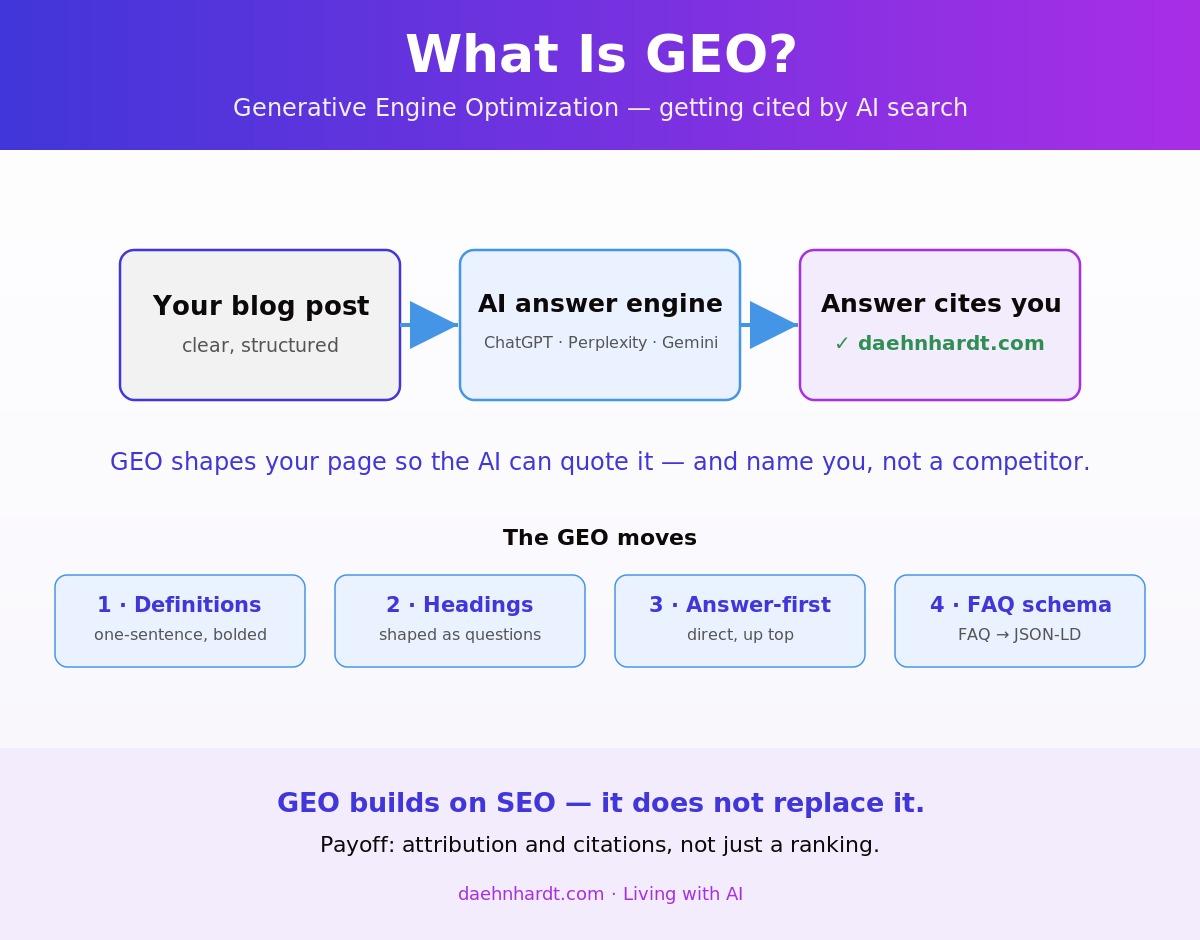
What Is GEO (Generative Engine Optimization)?
A reader asked me a question the other week, then told me they had already “checked with ChatGPT” first. The AI gave them a decent answer — and cited someone else’s blog. I had written about the exact topic. My post just wasn’t structured in a way the AI could lift.
That is the whole problem GEO solves. Generative Engine Optimization (GEO) is the practice of structuring content so AI answer engines — ChatGPT, Perplexity, Google AI Overviews — can parse it, quote it, and cite you as a primary source. In this post, I explain what GEO is, how it differs from SEO, and exactly what I changed across roughly 95 posts on this blog, including the first results.
GEO vs SEO: What Actually Changed
Search Engine Optimization (SEO) optimises a page to rank in a list of links that a human then clicks. GEO optimises the same page to be extracted and repeated inside an answer the AI writes for the user, often with no click at all.
They are not enemies. The same crawlable, trustworthy, well-written page feeds both. But the unit of success is different, and that changes what you emphasise:
| SEO | GEO | |
|---|---|---|
| Goal | Rank in a list of links | Be quoted in an AI answer |
| Unit | The page | A ~500-token chunk of the page |
| Reader | A human who clicks | An AI that synthesises |
| Wins on | Keywords, backlinks, page speed | Clear definitions, question-shaped headings, structured data, citations |
| Failure mode | Buried on page 2 | Content the model can’t cleanly extract |
It also helps to split GEO’s target into two answer types. In an extraction-based answer, the AI lifts a specific fact, definition, or block near-verbatim from a single page — this is where a self-contained, clearly-labelled chunk gets picked up whole. In a generation-based answer, the AI synthesises a new sentence out of several sources, and no single page gets quoted directly, though a distinctive fact or number can still surface, credited or not. Most of the tactics below are aimed at winning the extraction case, because that is the one where being clear and specific has a direct, visible payoff: your sentence, verbatim, with your name on it.
Here is the mental model I keep coming back to. SEO is getting your book onto the right library shelf, where someone might browse to it. GEO is the paragraph the librarian reads aloud when a reader asks a question. Same book — but the second job rewards a clean, self-contained paragraph the librarian can quote without flipping pages.
Why GEO Matters Now
More and more answers never become a click. When Google shows an AI Overview, or someone asks Perplexity directly, the “result” is a synthesised paragraph with a few cited sources. If you are not one of those citations, you are invisible — even if you would have ranked well in the old blue-link list.
This is not just vibes. The term GEO comes from a 2023 research paper, “GEO: Generative Engine Optimization”, from researchers at Princeton, Georgia Tech, the Allen Institute for AI, and IIT Delhi (published at KDD 2024). They built a benchmark of 10,000 queries and found that targeted GEO methods — adding citations, direct quotations, and statistics — lifted a source’s visibility in AI answers by up to 40%. Structure and evidence, not keyword stuffing.
Underneath the tactics sits one mechanic worth naming: a model cites the source that gives it information gain — a fact, number, or angle it cannot already produce from its own training data — and quietly skips the page that just restates what every other page already says. This is also why entity density matters. A paragraph packed with clearly named, unambiguous things — a specific library, dataset, error message, version number — is easy for a model to lift and attribute correctly. A paragraph about “modern approaches to the problem” is not, however well it once ranked. Keyword stuffing got you noticed in the old game; here, being genuinely specific is the whole game.
How I Applied GEO to This Blog
I did not rewrite anything from scratch. GEO, done well, is mostly restructuring what already reads well, so a machine can extract it. Concretely, across the posts I have worked through so far, each one gets:
- A one-sentence definition of every core concept, in the shape “X is a Y that does Z”, with the entity name in bold on first use. Semantic parsers love an unambiguous definition.
- Question-shaped headings.
IntroductionandMy rule of thumbcarry no meaning in a vector search.How to Restore Deleted Files in Gitmatches what a person actually types. So the headings became the questions. - Answer-first paragraphs. The direct answer goes in the first sentence of a section, not three paragraphs down after a story.
- Self-contained chunks. AI engines split a post into ~500-token pieces. A paragraph that opens with “It solves this by…” is meaningless once it is separated from the noun it refers to, so orphaned pronouns get replaced with the actual entity name.
- Structured data. A short
faq:block in the front matter emitsFAQPageJSON-LD automatically — a clean, machine-readable list of question/answer pairs. (This post carries one; scroll down.) - Clean-up. Raw HTML anchors became native Markdown heading IDs, every code block got a language label, and AI-hype filler (“revolutionising”, “delve deep”) got deleted because it lowers information density.
None of this changes my voice or misleads a human reader. It just stops burying the answer.
What the First Data Showed
I built a small monthly report to measure this rather than guess. The honest early picture: of ten pillar questions I care about, my blog shows up in organic Google results for two. My Decision Tree versus Random Forest post ranks first for its query, and my generating music with AI post surfaces near the top for its own.
But I have to be careful about what that proves. Both posts are years old — the Decision Tree one has ranked well since 2023, long before I touched it for GEO a few weeks ago. So that #1 spot is SEO talking: age, backlinks, a real code example, and the fact that the Titanic dataset is one of the most-searched teaching datasets. GEO did not earn that ranking, and I would be fooling you to claim it did.
What GEO actually targets is different — being cited inside an AI answer — and that is precisely what a plain organic-ranking check cannot see. So the honest status is this: the SEO groundwork is clearly there; whether the GEO pass adds AI citation on top of it is the thing I am now measuring. The pattern I already trust is narrower: GEO pays off on genuinely useful, evergreen content, not on news-cycle posts or thin pages. It sharpens a page for extraction; it does not manufacture authority you have not earned.
The gaps are just as useful. For “run flask app in docker” or “restore deleted files in git” I have solid posts but no visibility yet, so I aligned their headings and added an exact-question FAQ to the git recovery post and the Flask-in-Docker post. Next month’s report will tell me whether it moved anything.
Does GEO Actually Bring Human Traffic?
This is the fair question, so here is the straight answer: GEO is not a traffic firehose. Some AI answers cite you with a link, and the reader clicks through. Those visitors tend to be high-intent — the AI has already half-qualified them. But many answers satisfy the reader inline, and they never visit. That zero-click reality is real, and I will not pretend otherwise.
So why feed your content to AI at all? Because the choice is not whether AI reads your work — the crawlers already do, whatever you decide. The real choice is who gets the credit when an AI uses your content: you, or a competitor who structured their page more clearly. GEO is how you make the answer name you. Being the cited source builds recognition and trust even on the visits you do not get, and it is increasingly defensive: as more searches end inside an AI answer, a page that only wins the old blue-link game slowly goes quiet.
In my opinion, that trade is worth taking — with eyes open. Do the SEO groundwork so humans can still find and click you, then add GEO so the machines quote you instead of someone else. What I will not do is promise a traffic spike I cannot yet prove. Ask me again after a few monthly reports.
A GEO Checklist You Can Steal
If you remember nothing else, do these on your most useful posts:
- Put a one-sentence, bolded definition of the main concept near the top.
- Rewrite headings as the questions people actually ask.
- Lead each section with the direct answer, then explain.
- Make each paragraph make sense on its own — no orphaned “it” or “they”.
- Add an FAQ (and, for step-by-step guides,
HowTo) as structured data. - Cite primary sources — the official docs, the original paper — not third-hand blogs.
- Measure it, and be honest when a page simply is not good enough yet.
For the traditional half of the job, my older write-up on moving to GA4 and SEO basics still applies — GEO sits on top of that, it does not replace it.
Final Thoughts
GEO is not a trick, and it is not the death of SEO. It is writing for two readers at once: the human who wants a clear, honest answer, and the machine that wants to quote it accurately. Do the first well and structure the second, and you’ll stop losing your own topics to someone else’s blog.
I am still early in this, and I would rather show you the real numbers than a confident promise. Read in a couple of months once the data comes in.
References
- GEO: Generative Engine Optimization — Princeton et al. (KDD 2024)
- llms.txt — the proposed standard for AI crawlers (Jeremy Howard)
- llms.txt explained — Search Engine Land
- Schema.org structured data
- Decision Tree versus Random Forest, and Hyperparameter Optimisation
- Generate Music with AI
- Moving to GA4
GEO FAQ
What is generative engine optimization (GEO)?
GEO (generative engine optimization) is the practice of structuring content so AI answer engines — ChatGPT, Perplexity, Google AI Overviews — can parse, quote, and cite it. Where SEO competes for a link in a ranked list, GEO competes to be the sentence the AI repeats.
What is the difference between GEO and SEO?
SEO optimises for ranking in a list of links a human clicks; GEO optimises for being extracted and cited inside an AI-generated answer. They overlap (crawlable HTML, real authority, useful content), but GEO adds entity-clear definitions, question-shaped headings, self-contained chunks, and structured data.
Does GEO replace SEO?
No. GEO builds on SEO rather than replacing it — the same crawlable, authoritative page serves both. Most GEO wins in my measurements came from evergreen how-to posts that were already solid SEO content, then restructured for extraction.
Does GEO bring traffic to my website?
Partly. Some AI answers cite you with a link and send high-intent visitors, but many are answered inline with no click — the “zero-click” reality. GEO’s bigger payoff is attribution: being the named, cited source builds trust and is defensive as search shifts into AI answers. Keep doing SEO for the human clicks, and add GEO so AI credits you rather than a competitor.
What are the highest-impact GEO tactics?
One-sentence entity definitions, question-shaped headings that match how people actually ask, answer-first paragraphs, self-contained chunks (no orphaned pronouns), FAQ/HowTo structured data, and citing primary sources. The Princeton GEO study found that adding citations, quotations, and statistics lifted AI visibility by up to 40%.
Stay Ahead in AI, Machine Learning & Python
No hype. Weekly notes on AI tools, Python, and what I'm actually building — plus seven free gifts, including Fantastic AI: The 2026 Toolkit and Git Commands and Contribution Workflow Cheatsheet.

You're in
Check your inbox for Set a password to unlock articles if you want gated tutorials. Log in with the same email.