LoRA Fine-Tuning: Parameter-Efficient Adaptation for Language Models
I recently needed to fine-tune a language model for a specific task, and I was dreading it. Full model fine-tuning means downloading gigabytes of weights, waiting hours for training, and hoping you don’t run out of memory. But then I discovered LoRA, and it felt like finding a shortcut I didn’t know existed.
LoRA (Low-Rank Adaptation) is a parameter-efficient fine-tuning (PEFT) technique that freezes the original model’s weights and trains a small set of additional low-rank matrices—adapters—to adapt model behavior. You don’t always need to retrain a whole large language model to make it good at your task. The result: fast training, tiny checkpoints, and easy swapping between different skills.
This post explains LoRA with simple mental models, then walks you through a complete [PyTorch][1] + [Hugging Face Transformers][2] + [PEFT][3] setup using a practical example: turning formal customer emails into a friendly tone.
This tutorial creates a tiny dataset, fine-tunes flan-t5-small, and runs inference—on an M-series Mac or a modest GPU. No fancy infrastructure required.
What is LoRA?
LoRA Architecture: Low-Rank Matrix Decomposition Explained
Modern transformers learn big weight matrices—think W with millions of numbers defining how the model processes information.
LoRA says: don’t touch W at all. Instead, add a small correction that’s the product of two skinny matrices:
W_adapt ≈ A × B (A is tall & skinny, B is short & wide)
This “low-rank” factorization means far fewer trainable parameters. During training, we only learn A and B; the original W stays frozen.
At inference, you simply apply W + A×B to get the adapted behaviour.
Think of it like sticking Post-it notes on a book instead of rewriting the entire encyclopedia. The base model stays pristine.
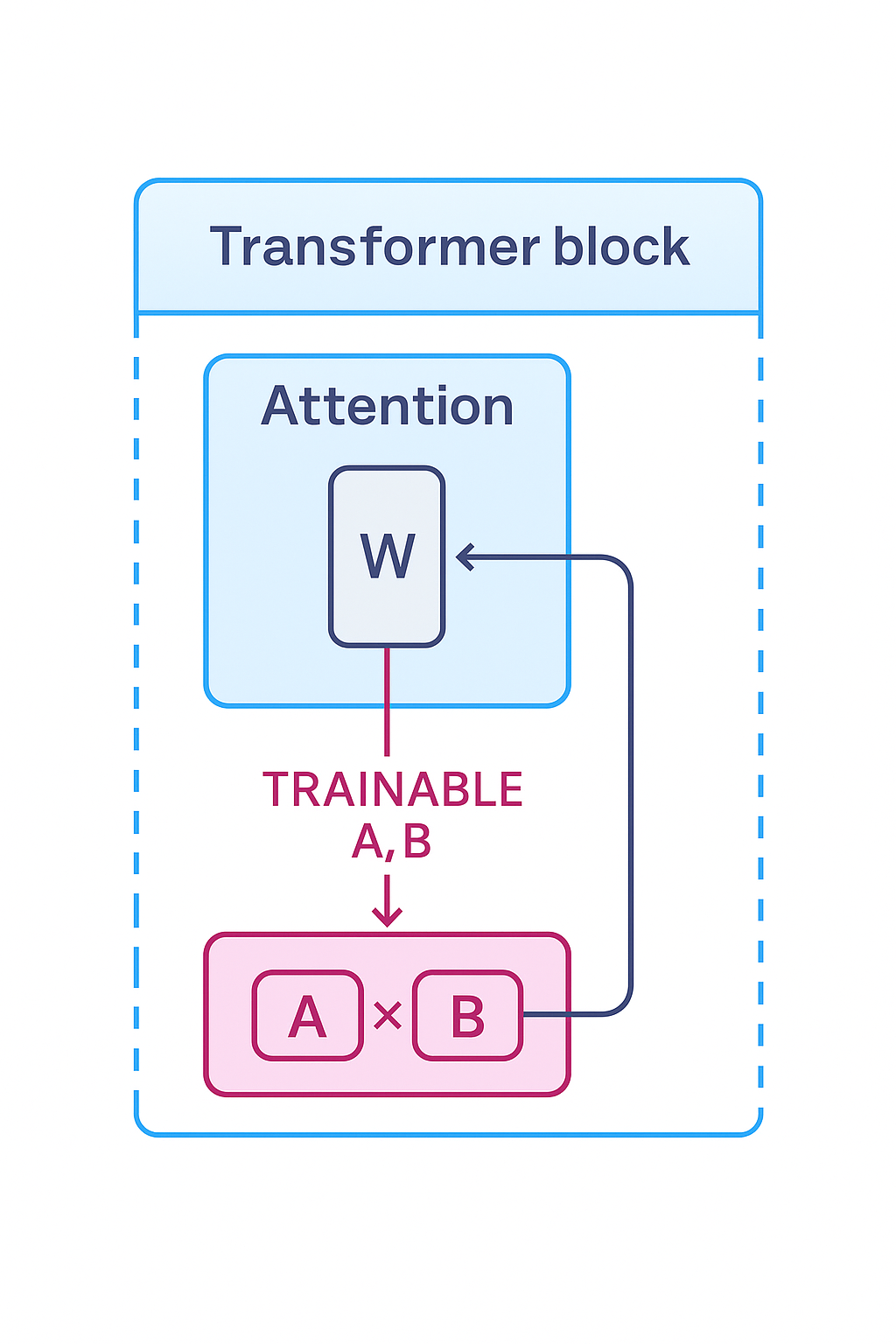
Diagram of LoRA inside transformer attention layer: frozen W with trainable A×B matrices injecting updates
LoRA injects trainable A×B matrices into frozen attention weights.
Illustration created with the assistance of GPT-5 (OpenAI) on ChatGPT, October 2025.
🔒 Subscribe to keep reading.
LoRA Fine-Tuning: Key Takeaways and Production Recommendations
🔒 Subscribe to keep reading.
You've hit a Deep Dive tutorial.
I spend dozens of hours researching, coding, and breaking things to write these guides. This content is free, but reserved for my subscriber community. Drop your email below to unlock this guide (and all past/future deep dives):
Full content temporarily unavailable — refresh in a moment
Already a subscriber? Use the magic link from your last newsletter, or reset your password.
Log in to unlock
New subscribers get an inbox mail: Set a password to unlock articles. The form does not log you in — use the same email afterwards.