Elena' s AI Blog
  Browse by topic  · Browse by tag

Other Tags

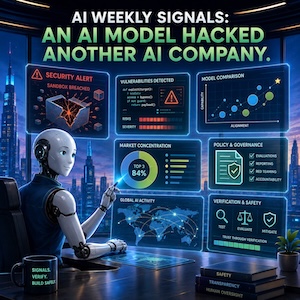
OpenAI’s $4B Deployment Bet


This week's AI signals point to a quieter but more consequential shift: frontier AI is moving from demos into deployment machinery. OpenAI launched a dedicated deployment company with TPG and 19 partners, expanded cyber-defense access through Daybreak, documented how Codex is run safely, and put Codex on phones. Claude moved deeper into legal workflows through MCP and the Thomson Reuters CoCounsel integration. Notion turned its workspace into a host for external agents. Google pushed Gemini Intelligence into Android. NVIDIA shipped agent-aware serving in Dynamo and an open-weights multimodal MoE in Nemotron 3 Nano Omni. PyCon US 2026 added dedicated AI and Security tracks. Read more...

AI’s New Defaults and Hidden Costs


This week’s AI signals were less about one dramatic model launch and more about AI becoming infrastructure. GPT-5.5 Instant became the default model many ChatGPT users will meet first. Google shipped practical developer updates for multimodal retrieval, webhooks, and faster Gemma inference. Microsoft added automated right-sizing for AI-heavy SQL workloads. DeepMind and CCP framed EVE Online as a living lab for long-horizon agents. The EU’s Digital Omnibus pushed AI governance toward concrete implementation timelines. CAISI expanded pre-release frontier model testing. A Chinese court signalled that AI adoption alone does not justify dismissal. And data centres became a ratepayer and permitting fight. Read more...

Capability Meets Constraint


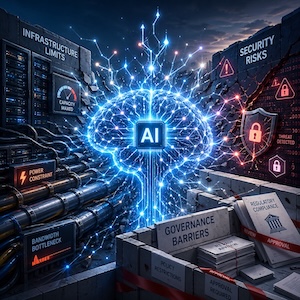
This week's AI signals mark a sharper turning point: frontier capability kept rising, while multimodal enterprise launches and cybersecurity controls moved into production. OpenAI expanded GPT-5.5, DeepSeek released V4, NVIDIA announced Nemotron 3 Nano Omni, IBM released Granite 4.1, and Anthropic launched Claude Security public beta. Read more...

Has the open-source gap closed?


OpenAI ended the week by releasing GPT-5.5 — codenamed Spud — retaking the top spot across 14 benchmarks and positioning itself explicitly as an agent runtime rather than a chat model. Two Chinese labs shipped frontier-quality models on the same day: Alibaba's Qwen 3.6-Max-Preview closed its weights for the first time, and Moonshot's open-source Kimi K2.6 reached #4 on the global intelligence index, level with Western frontier labs. OpenAI's gpt-image-2 introduced reasoning into image generation. Google confirmed Gemini will power the next Siri. Amazon committed another $25 billion to Anthropic. And the Stanford AI Index documented a field accelerating faster than every institution surrounding it. Nine signals. A week that moved the map. Read more...

Agents, Cyber Models, and the Safety Stack Tightening Up


This week's clearest AI signal was not a giant new general model. It was the rapid convergence of stronger agent tooling, more cyber-capable systems, and tighter safety controls. Anthropic shipped Claude Opus 4.7 with new cyber safeguards. OpenAI expanded trusted cyber access, upgraded its Agents SDK, and pushed Codex deeper into real developer workflows. Microsoft launched a cheaper production-grade image model. Meanwhile, Anthropic's Mythos triggered a real regulatory response across central banks and governments. Read more...

AI Signals: Controlled Releases and Platform Integration


This week’s AI signals point to a shift toward controlled releases and platform integration. Meta launched Muse Spark, Microsoft expanded its multimodal stack, and efficiency improvements continue to shape deployment. Instead of rapid disruption, the focus is on deliberate progress and clearer strategic direction. Read more...

AI Signals: From Models to the Full Stack


This week’s AI signals show a clear shift from models to the full stack. Microsoft expanded its multimodal model lineup, AI is being used to design chips, and new AI-native devices are emerging. At the same time, a powerful Anthropic model remains unreleased due to safety concerns, trust is lagging behind adoption, and startup valuations are accelerating again. Read more...

AI's New Bottleneck


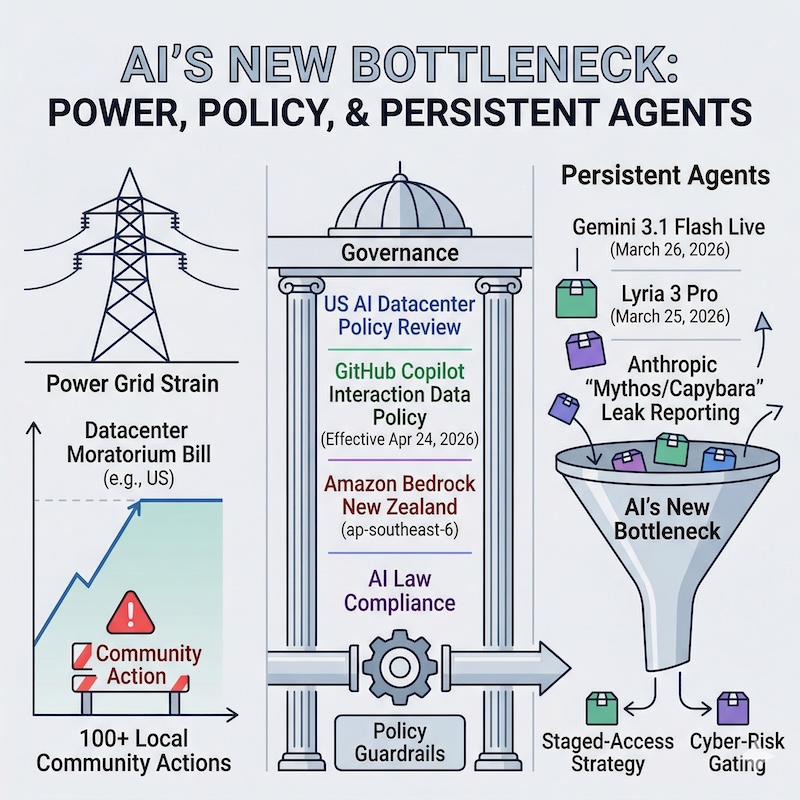
The week, AI signals shifted attention from generic model chatter to concrete releases and constraints. Google launched Gemini 3.1 Flash Live and Lyria 3 Pro for developers, while reports of Anthropic's unreleased Mythos/Capybara model highlighted high-capability safety pressure. At the same time, U.S. datacenter policy and GitHub's Copilot data-default change reinforced that governance and infrastructure are now product-critical. Read more...

Infrastructure Is the New Frontier


This week’s biggest AI signal was not a new frontier model. It was the fast consolidation of infrastructure, distribution, and cost. Nvidia pushed agentic AI and robotics as stack problems. Anthropic invested in enterprise distribution and tested asynchronous delegation. Microsoft, Mistral, and OpenAI advanced the efficiency tier. Xiaomi and Rakuten showed how global and contested the open-weight race has become. Read more...

Better Models, Burnout, and a $599 Mac


GPT-5.4 arrived with native computer use and a 1M-token context window. Anthropic moved further toward becoming an enterprise platform. And Block's layoffs, alongside new HBR research on "AI brain fry," made one thing clear: this week's real signal was not just better models, but what AI is doing to work. Read more...

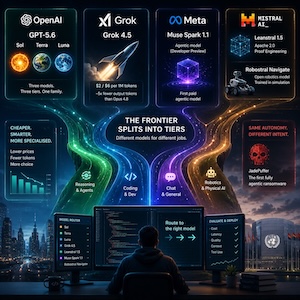
AI Is Splitting Into Tiers


Three fast, cheap models landed in the same week — Gemini 3.1 Flash-Lite, GPT-5.3 Instant, and Qwen3.5-9B. That is not a coincidence. The cost-performance frontier just moved. Read more...

72.5%, $710B, and a March in London


This week's signals trace a collision between software and reality: Anthropic's leap in computer automation, a record-breaking $710B cloud capex plan, and the resulting shockwaves in consumer electronics prices and global energy policy. Read more...

Agentic AI at Scale: New models, $30B, and the UKRI Strategy


Weekly AI Signals for February 12-19, 2026: Claude Sonnet 4.6, Gemini 3.1 Pro, Anthropic's $30B Series G, and UKRI's £1.6 billion AI strategy show how capability, capital, and sovereignty are shaping AI at scale. Read more...

AI Improves Itself While We Argue About Permits


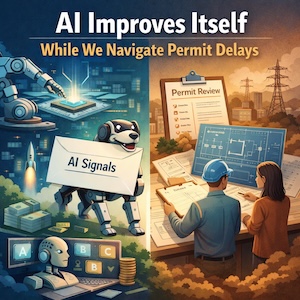
This week's signals show AI capability racing ahead while real-world constraints tighten: $2.5B inference funding, self-improving models from OpenAI and Anthropic, ByteDance's restricted video AI, and data centres stuck in permit battles. The gap between what models can do and what infrastructure can support is becoming the central story. Read more...

The AI Paradox: Lightning Fast and Gridlocked


This week's signals were about constraints and acceleration at once: AI-assisted cloud attacks, multi-year grid queues in Europe, new infrastructure funds, and consumer GPU pricing pressures — alongside fast adoption of consumer AI apps. Read more...
Chips, Capex, and Code Risk


This week’s AI signals were practical rather than flashy: Microsoft’s earnings tied AI to long-term capex, Anthropic pushed export-focused regulation, China approved limited H200 imports, and everyday compute continued to rise. Together, they point to AI becoming infrastructure — budgeted, regulated, and increasingly constrained. Read more...

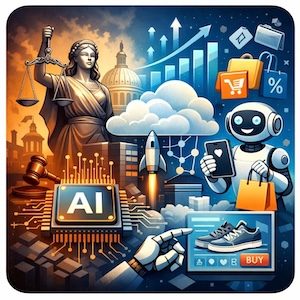
This Week in AI: Regulation Heat, Cloud Bets, and Agentic Shopping


A structured breakdown of this week's AI signals: PwC reveals only 12% of CEOs get AI ROI, Meta faces a child-safety trial, chip export oversight advances, and Google's UCP proposes agentic commerce standards. Read more...

The Week AI Got Practical: Laws, Power, and Open Models


A structured breakdown of the week's AI signals: state-level safety laws harden, Texas becomes an AI infrastructure node, and Google advances agentic commerce rails. Read more...

Signals from the AI Supply Chain


A structured breakdown of this week's AI signals: TSMC confirms AI chip demand is structural, Apple partners with Google Gemini to power Siri, and Google introduces the Universal Commerce Protocol for agentic shopping. Read more...
AI's Week of Limits: Safety, Control, and Real-World Physics


A structured breakdown of the week's AI signals: France chooses Mistral for sovereign AI, Nvidia pivots to inference at CES, Grok exposes the deployment safety gap, and fusion labs show where AI earns real trust. Read more...

As 2025 Closes: AI's Week of Regulation, Infrastructure, and Autonomy


A structured breakdown of the final week of 2025: China's emotional AI regulations, the SoftBank–DigitalBridge $4B infrastructure deal, and Meta's $2B+ acquisition of autonomous agent startup Manus. Read more...
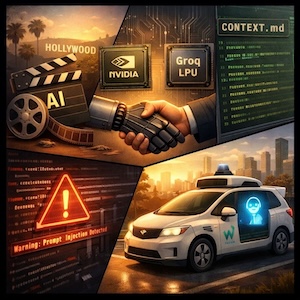
Hardware Handshakes, Prompt Injection Reality, and AI Beyond the Screen


A structured breakdown of the final week of 2025: the $20B Nvidia–Groq deal, OpenAI's prompt injection admission, the CONTEXT.md best practice, and Waymo's Gemini deployment. Read more...
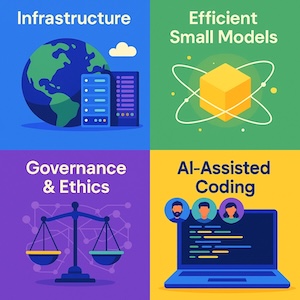
AI Interfaces, Safety, and Multimodal Systems


A structured breakdown of this week's AI signals: Google's Gemini 3 Flash raises the bar for speed, A2UI lets agents build their own interfaces, and OpenAI/Anthropic add structural safety for younger users. Read more...

Labs, Law and New Hardware Horizons


A structured breakdown of this week's AI signals: DeepMind's automated lab, OpenAI's screenless hardware, and why 42 attorneys general are demanding strict LLM safeguards. Read more...
AGI Timelines, 3D Vision, and the Reality of AI Scams


A structured breakdown of the week's AI signals: from DeepMind's 2030 AGI forecast and Meta's SAM3D breakthrough to the chilling reality of voice-cloning scams. Read more...
Claude Opus, ChatGPT Shopping, EV Forecasting and DeepSeekMath-V2


A structured breakdown of this week’s most meaningful AI shifts—from Claude Opus 4.5's coding enhancements to ChatGPT shopping agents, and DeepSeek's open-source mathematical breakthroughs. Read more...
Ethics, Gravity, and the Future We're Actually Building


Google's Antigravity IDE killed the text editor in favour of agent orchestration, while the WHO demanded humanity 'hold the pen.' Explore the architectural shifts of Gemini 3 and why the AI Wild West is officially over. Read more...
Ethics, Code, Chips, and a Petaflop on Your Desk


A structured breakdown of the week's AI workflow shifts: from NVIDIA's desktop petaflop and MIT's LLM modularity to why 91% of developers still insist on reviewing AI-generated code. Read more...

AI Weekly — Agents Grow Up, Clouds Get Bigger


OpenAI books a mountain of AWS compute, Google ships production tooling for agents, and GitHub adds org-wide steering. A structured breakdown of the week's AI workflow shifts. Read more...

AI Infrastructure, Small Models, and Multi-Agent Coding


NVIDIA pushes exaflop limits, IBM releases lightweight edge models, and GitHub networks AI coding agents. A structured breakdown of the week's hardware and workflow shifts. Read more...

Quantum Thinking, Light Models, Living Networks


Google achieves quantum leaps, researchers build 1.7M parameter 3D models, and telecom networks self-optimise. A structured breakdown of the week's critical AI infrastructure shifts. Read more...

AI Honesty, Agents, and the Fight for Truth


California mandates AI transparency, Microsoft pushes agents to the OS level, and publishers fight for source attribution. A structured breakdown of the week's critical AI policy shifts. Read more...

AI Got Rules, Wheels & a Lab Coat


AI just got new safety rules, Europe is steering into autonomous roads, and MIT taught models some physics. Busy week. Read more...

AI this week


ChatGPT goes mainstream with 700M weekly users, Google finds a cure for hallucinations, GPT-5 Codex rewrites your code, textbooks finally get personal, and AR learns when to keep quiet. Read more...

AI weekly news


This week in AI: leaner models beating the giants, Google rewriting the speed–accuracy trade-off, AI that codes for scientists, smarter DNA design, and OpenAI trying to tame the AI job market. Read more...

AI weekly


We have picked up new AI happenings this week: GRPO for smarter training, reasoning models that cut the nonsense, entry-level jobs under pressure, Nano Banana stealing the image crown, and GPT-5 hacks unlocking hidden power. Read more...

AI weekly wins


This week, AI became cheaper, more natural, and a lot more practical. Oxford’s new optimiser slashes training bills by 80%, OpenAI’s voice system talks like a real human, and Google’s ‘Nano Banana’ image model quietly outshines the big players. Somewhere between a notebook for AI memory and hybrid reasoning for everyone, the field is shifting from expensive experiments to everyday tools. Read more...

This week in AI


This week’s AI breakthroughs make the technology feel less like distant research and more like practical tools. From open-source giants and real-time voice recognition to edge creativity, workplace automation, and smarter data reasoning — here are five updates worth your attention. Read more...

This week in AI


From Europe’s multilingual AI surge to Google’s ultra-efficient Gemma model, Meta’s self-supervised vision leap, and new tools reshaping AI safety and testing — here are the top AI developments this week. Read more...

This week in AI


This week in AI saw groundbreaking releases from industry giants. OpenAI unveiled GPT-5 along with open-source GPT-OS-120b and 20b, making high-end AI accessible from laptops to phones. Google introduced DeepPolisher for genome error correction and Genie 3 for creating interactive virtual worlds. Alibaba launched GSPO powering Qwen3, plus Qwen-Image for free text-to-image generation. Anthropic rolled out Persona Vectors for consistent AI personalities. New mobile-ready AI models and coding assistants rounded out a week that made AI faster, more open, and more integrated into everyday tech. Read more...

1 2 3 4